What is the contribution of William Herschel?
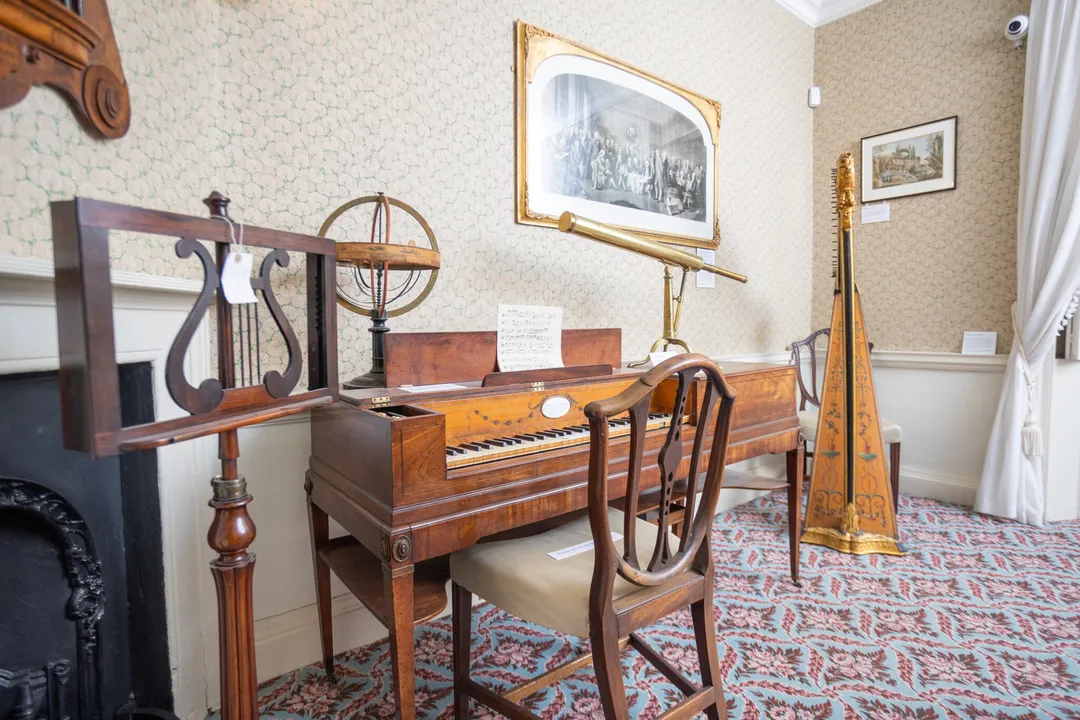
The name William Herschel resonates through astronomical history not just because he found a new world, but because he fundamentally changed how humanity looked at the cosmos—seeing far deeper into space and discovering parts of light previously invisible to the eye. Before he was charting nebulae, however, his world was one of music. Born in Hanover, Germany, in 1738, his initial career was firmly rooted in the performing arts. He was a highly skilled musician, playing the oboe and later serving as an organist, and he even composed numerous musical pieces. This period of intense musical training, which demands an acute sensitivity to subtle variations in tone and frequency, perhaps instilled in him an enduring patience for detecting faint signals, whether in an orchestral piece or in the dim glow of a distant star.
# Early Music Career

Herschel began his professional life in the military band of the Hanoverian Guard before moving to England around 1757. In England, he established himself as a successful musician, teaching, performing, and composing in cities like Bath. His income derived from these musical endeavors provided the financial platform that eventually allowed him to dedicate himself fully to astronomy, a passion that had been growing since his move to England. This transition from the concert hall to the observatory marks one of the most dramatic career shifts in scientific history, proving that deep-seated intellectual curiosity can successfully overcome established professional paths.
# Mirror Crafting

A defining characteristic of Herschel’s astronomical contribution was his insistence on engineering his own equipment. Unlike many of his contemporaries who relied on commercially or institutionally produced telescopes, Herschel recognized that to push the boundaries of observation, he had to push the boundaries of optics himself. He ground and polished his own mirrors, a grueling, physically demanding process that required immense dedication. He favored reflecting telescopes because, at the time, large refractors suffered terribly from chromatic aberration—the blurring of colors—which limited their effective magnification. His mastery of mirror-making allowed him to construct instruments of unparalleled size and light-gathering power for his era. This self-sufficiency in instrument design is a critical point; without his dedication to perfecting the mirror, his subsequent discoveries would have remained out of reach, suggesting that for certain periods of scientific advancement, the toolmaker must precede the discoverer.
He started with a 6-foot reflector, then moved to 10-foot, and later 20-foot designs. His crowning achievement in this arena was the construction of his famous 40-foot telescope, completed in 1789 at his home in Slough. This behemoth featured a primary mirror spanning four feet in diameter. Though the design introduced new mechanical challenges, it allowed him to achieve magnifications that were unprecedented, enabling him to survey the heavens with clarity unmatched by anyone else in the world.
# Uranus Discovery
The turning point in his scientific career, and the event that secured his patronage, was the discovery of Uranus in 1781. While systematically surveying the sky, Herschel initially mistook the object for a comet. After weeks of careful observation and calculation, he realized that its path indicated it was, in fact, a new planet orbiting beyond Saturn—the first planet to be discovered since antiquity. This finding propelled him from relative obscurity in Bath to international fame.
The discovery brought him immediate royal recognition. In 1782, King George III appointed him Astronomer Royal. This position came with a stipend that finally allowed Herschel to give up music entirely and dedicate himself full-time to astronomy. The nature of this royal appointment is telling; it cemented a partnership between the Crown and cutting-edge science, funding observational astronomy directly.
# Star Surveys
With the security provided by the King and the power of his ever-improving telescopes, Herschel turned his attention to the structure of the universe itself. His goal was systematic observation, moving away from serendipitous finds to comprehensive mapping. He and his sister, Caroline, began an exhaustive survey of the sky, meticulously cataloging double stars, nebulae, and star clusters.
Herschel was instrumental in differentiating between what were then called nebulae: some were star clusters, and others were truly nebulous clouds of gas and dust. He proposed the concept of the Milky Way being a flattened, disk-like system, and he attempted to map the distribution of stars within it, creating "star gauges" to count the stars visible in various directions. His work laid the foundational groundwork for the study of galactic structure, even if his initial conclusions about the Sun's central position in the galaxy were later revised.
| Instrument Type | Typical Mirror Size | Significance | Citation |
|---|---|---|---|
| Early Reflectors | 6 to 20 feet | Allowed for self-funded high-power views. | |
| 40-Foot Telescope | 4 feet diameter | Largest and most powerful of its time. |
# Invisible Heat
Perhaps an even more profound, though initially less recognized, contribution was his discovery of a radiation fundamentally different from visible light. In 1800, while experimenting with sunlight passed through a prism, Herschel noticed that the thermometer placed just beyond the visible red end of the spectrum consistently registered a higher temperature than thermometers placed within the visible light bands.
He correctly deduced that this extra heat must be caused by an invisible form of light energy. He termed this discovery calorific rays, which we now recognize as infrared radiation. This groundbreaking experiment demonstrated that the spectrum of light visible to the human eye was only a small portion of a much larger reality. Considering his background, it’s fascinating to note how this investigation into the fundamental properties of light—detecting something that wasn't seen but could be measured—shows a continuity with his earlier life dedicated to perceiving and manipulating sound waves, an equally invisible medium. This single experiment opened the door to the entire electromagnetic spectrum, paving the way for everything from radio astronomy to modern thermal imaging.
# Sister Partnership
It is impossible to discuss William Herschel’s contributions without acknowledging his sister, Caroline Herschel. She moved to England to work as his assistant, initially helping with his musical transcription work. Once William shifted focus, Caroline became an indispensable astronomical collaborator. She managed the meticulous record-keeping, performed complex calculations, and even swept the mirrors for dust. Crucially, Caroline became a distinguished astronomer in her own right, discovering several comets and nebulae independently. Her dedicated, disciplined support enabled William to spend the long, cold nights at the eyepiece of his massive telescopes, making the discoveries possible.
# Lasting Impact
William Herschel's lifetime of observation reshaped astronomy from a largely theoretical or observational discipline focused on the Solar System into a dynamic, structural science. He was knighted for his service, cementing his status in British scientific circles. His contributions can be summarized in three major shifts: first, the expansion of the known Solar System with the detection of Uranus; second, the systematic mapping and cataloging of the deep sky, transforming nebulae from fuzzy smudges into discrete objects that formed the architecture of the galaxy; and third, the discovery of infrared energy, which revealed that the universe communicates using forms of energy our eyes cannot perceive. By building his own superior tools, demonstrating relentless observational discipline, and possessing the intuitive leap to test beyond the visible, Herschel established a benchmark for observational astrophysics that lasted for generations.
Related Questions
#Citations
William Herschel | Biography, Education, Telescopes, & Facts
William Herschel
Caroline and William Herschel: Revealing the invisible
A Giant of Astronomy
William Herschel | Biography, Discoveries & Significance
Sir John Frederick William Herschel - Getty Museum
Frederick William Herschel (1738–1822)
Herschel and the Puzzle of Infrared
History - Herschel Museum