How far away can you hear a rocket take off?
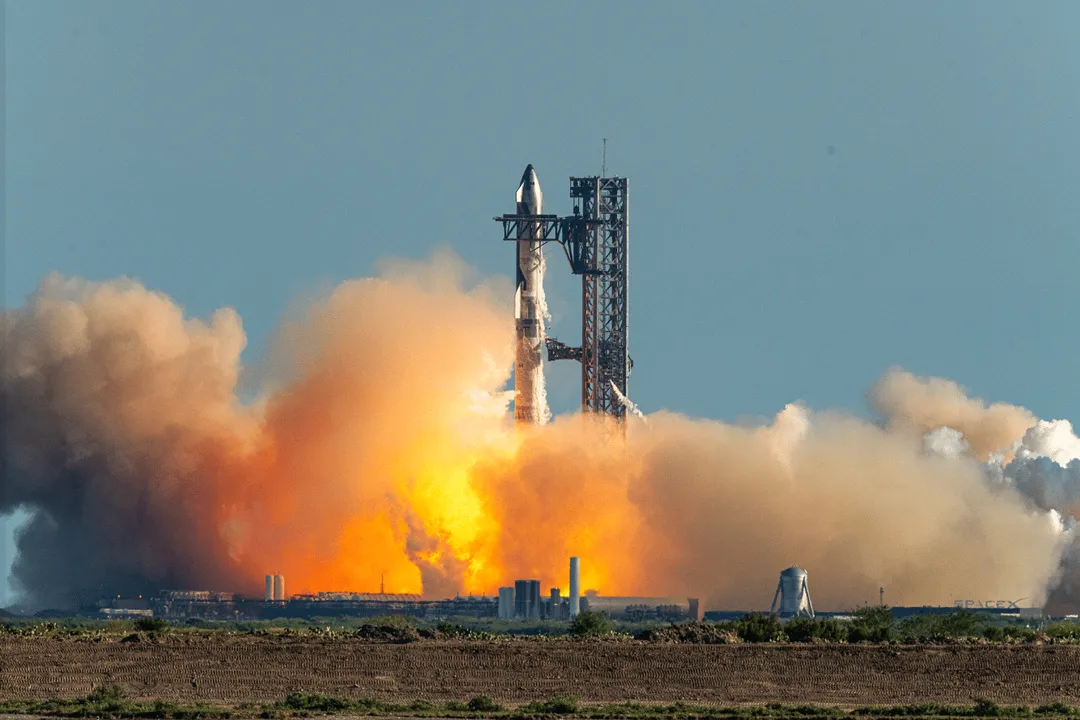
The deep, chest-thumping roar of a massive rocket clearing the pad is an elemental experience, a sound that travels farther than most people imagine. Asking how far away you can hear a launch isn't a question with a single number; it’s an inquiry into atmospheric physics, the sheer magnitude of the machinery, and a bit of luck regarding the weather. While people close to the launch site might experience noise levels capable of causing physical harm, the audible footprint of these behemoths extends surprisingly far across the landscape. [9]
# Launch Power
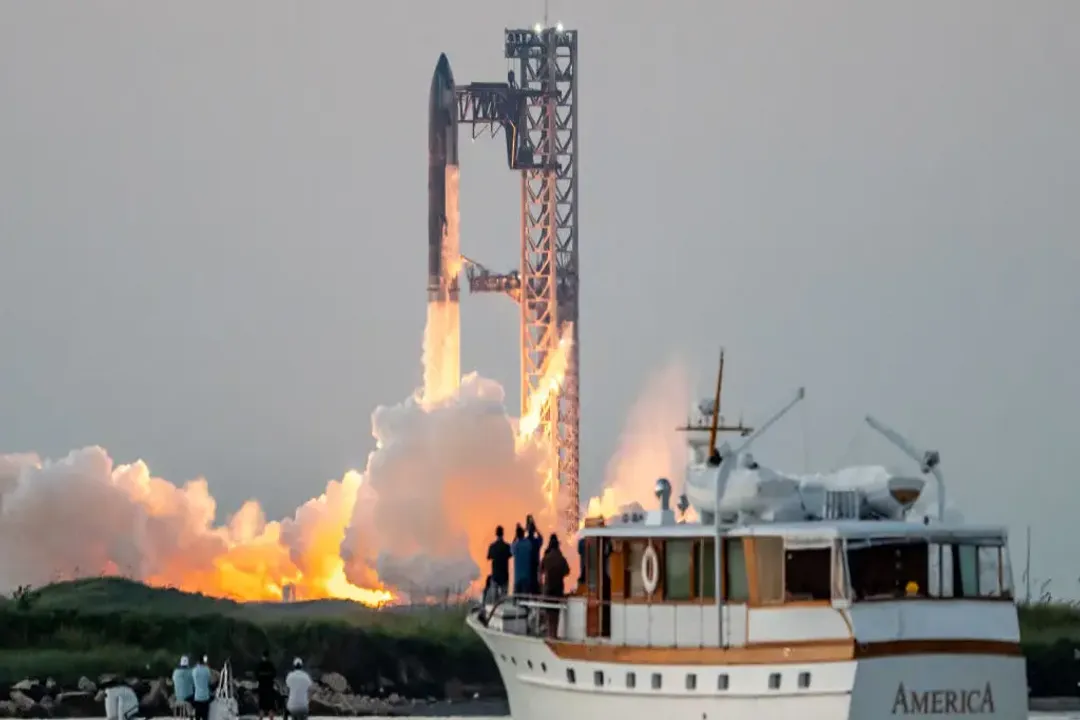
The distance sound carries is directly proportional to how loud the source is, and modern rocketry is impressively loud. The thrust generated by these vehicles converts enormous amounts of energy into acoustic power. For instance, when comparing the noise generated by current heavy-lift vehicles, the difference can be striking. Recent testing involving the SpaceX Starship Super Heavy booster indicated that its sound level was measured at roughly ten times the level of the Falcon 9. [6]
This exponential difference in acoustic energy is significant. When dealing with sound propagation over long distances, small increases in initial decibels translate into much greater reach. A study concerning the intense acoustic environment of the Starship Super Heavy suggested that its sound intensity levels were considerably louder than those from previous generations of rockets. [10]
# Range Estimates
The audible range varies dramatically depending on the specific vehicle and atmospheric conditions. For the legendary Saturn V, which powered the Apollo missions, the sound was reportedly audible for hundreds of miles under favorable conditions. [9] Some accounts suggest that from a launch on Florida’s coast, the sound could potentially be heard in neighboring states like Georgia or South Carolina. [9]
For more common launches today, the general consensus among enthusiasts and observers is that a powerful launch can often be heard up to 100 miles away, assuming clear line-of-sight and good atmospheric transmission. [1] However, in dense, urbanized areas, local noise pollution can drown out even a strong launch signal much closer to the site. [1][3] On a site like Reddit dedicated to space news, observers often confirm hearing launches from several states away, though the sound might arrive as a low rumble rather than the sharp crack heard nearby. [1] The sound pressure level (SPL) signature drops off rapidly as the distance increases. [3]
# Sound Physics
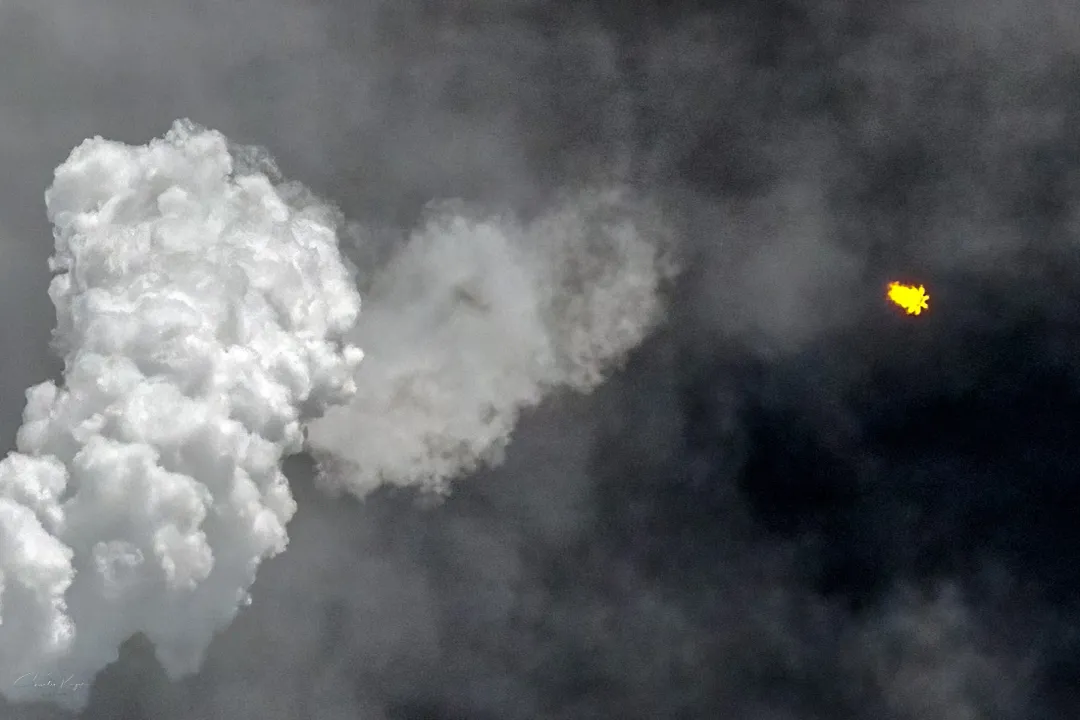
The actual distance a rocket's sound travels is less about a set radius and more about creating the right acoustic environment. Sound transmission is heavily influenced by atmospheric factors such as wind, temperature gradients, and humidity. [3]
Wind direction is perhaps the most intuitive factor. If the wind is blowing toward a listener, the sound waves are carried and concentrated in that direction, vastly extending the audible range. [3] Conversely, if the wind is blowing away from an observer, the sound will dissipate much quicker. A common recommendation for optimal listening is to position oneself downwind of the launch site. [3]
Temperature inversions—where a layer of warmer air sits above cooler air near the ground—can act like a natural acoustic mirror, bending sound waves back down to the surface. [3] This effect can carry low-frequency sounds, like the bass rumble of a rocket engine, much farther than they would travel on a still, uniformly cool day. Conversely, features like large hills or mountain ranges can create significant "acoustic shadows," blocking sound transmission entirely in certain valleys or behind the obstruction. [3]
If you are planning a trip to a viewing location, understanding that the best acoustic experience aligns with the meteorological forecast—not just the visual one—is key. For example, an observer expecting to hear a distant launch might be disappointed if an unexpected crosswind pushes the sound plume hundreds of miles north, while someone south of the launch site enjoys a surprisingly clear, low-frequency transmission due to a temperature inversion. [8]
# Intensity and Danger
It is vital to distinguish between what is audible and what is dangerous. While the low rumble might travel hundreds of miles, the initial acoustic blast near the pad is physically destructive. The sound pressure level (SPL) generated by a massive rocket like the Saturn V was calculated to be potentially lethal—above the human ear’s tolerance threshold of about —within a very small radius of the launch tower. [9] Even the lower-frequency sound waves present at a distance can cause physical vibrations that, while not painful, are certainly felt deep within the body.
The sound energy is distributed across the sphere radiating outward from the launch point. As that sphere gets bigger, the energy per unit area shrinks according to the inverse-square law, which dictates that intensity decreases rapidly with distance. [3] This rapid decay explains why the harmful levels of sound are restricted to a few miles, while the faint, low-frequency energy can persist across state lines.
# Listening Considerations
For those seeking to experience the sound from a significant distance, proximity to ground clutter matters. A good line of sight is preferable, meaning open fields, plains, or the ocean provide better acoustic pathways than heavily forested areas or cities filled with sound-absorbing structures. [3]
When trying to discern a launch sound from many miles away, you are primarily listening for the very low-frequency components of the engine noise. These long-wavelength sounds penetrate obstacles and travel farther than the higher-frequency components that you hear when standing close by. This often means that what you hear miles away is a deep, resonant thud or rumble, not the sharp roar you see in videos taken near the pad. [5] Thinking about this phenomenon, one can realize that the quality of the sound heard at 150 miles is entirely different from the sound at 15 miles; the atmosphere acts as a massive, natural frequency filter, stripping away all but the deepest bass notes of the engine signature.
If you are specifically trying to hear a launch from a remote location, it is worth checking local community discussions or launch schedules, as dedicated groups often coordinate listening efforts and report their findings regarding sound propagation on any given day, factoring in the real-world weather data for that specific time and location. [4] This communal knowledge sharing often provides better real-time distance metrics than theoretical models alone.
# Range Variability Snapshot
To illustrate the challenge of setting a single distance, consider how factors shift the boundary of audibility:
| Rocket Class | Near-Field Hazard (dB) | Estimated Max Audible Range (Ideal) | Key Attenuation Factor |
|---|---|---|---|
| Saturn V | Lethal () | Hundreds of miles | Extremely High Thrust |
| Starship Super Heavy | Higher than F9 | Likely further than F9 | Massive Thrust/Energy Output |
| Falcon 9 | Very High () | miles | High Thrust |
The critical takeaway is that the boundary where sound ends is constantly shifting, dictated minute-by-minute by the atmosphere, much like the boundary of a visual horizon on a hazy day. An observer might hear a launch today at 80 miles, but tomorrow, with a stiff headwind, they might hear nothing at 50 miles.
Another interesting observation one can make by comparing anecdotal reports is the effect of launch azimuth relative to the observer's location. When a rocket launches directly away from you on a path that carries the sound plume directly downwind, the effective range can be significantly greater than when the launch is broadside to your position, even if the direct line-of-sight distance is the same. The sound energy isn't just traveling out; it's being funneled and focused along the prevailing air currents. The science suggests that for exceptionally powerful launches, the sound energy can travel well over the horizon, constrained only by the strength of the atmospheric 'waveguide' that forms.
Ultimately, while a rocket launch is an event designed for sight, its acoustic impact travels far into the surrounding region, turning a visual spectacle into a regional, felt event, provided the air currents are aligned just right.
#Videos
How far away can you hear next week's Artemis I launch? - YouTube
Watching A Rocket Launch From 230 Miles Away - YouTube
#Citations
What is the maximum distance you can hear large rocket launches ...
How far away can a rocket launch be heard? - Quora
How far does the sound of a rocket launch carry?
How long after take off do you hear the sonic boom? - Facebook
How far away can you hear next week's Artemis I launch? - YouTube
In Texas, Starship Sound Level Measured at Ten Times That Of A ...
The Ultimate Guide to Viewing Rocket Launches from Florida
The Distance at Which a Saturn V Rocket Launch Would Kill You
Study captures the real rumble of SpaceX Starship heard from 20 ...