What is the process of accretion?
The concept of accretion describes a process of growth through gradual accumulation, where distinct pieces of matter or material slowly join together to form a larger whole. This seemingly simple mechanism is responsible for shaping some of the most massive structures in the cosmos and for slowly building up continents here on Earth. [1][6] It is not a sudden merger but a drawn-out process driven by fundamental forces, primarily gravity in space and physical contact or movement on our planet. [2][5] While the scales—from stellar nurseries to coastlines—differ vastly, the underlying principle of adding mass over time remains constant. [7]
# Cosmic Buildup
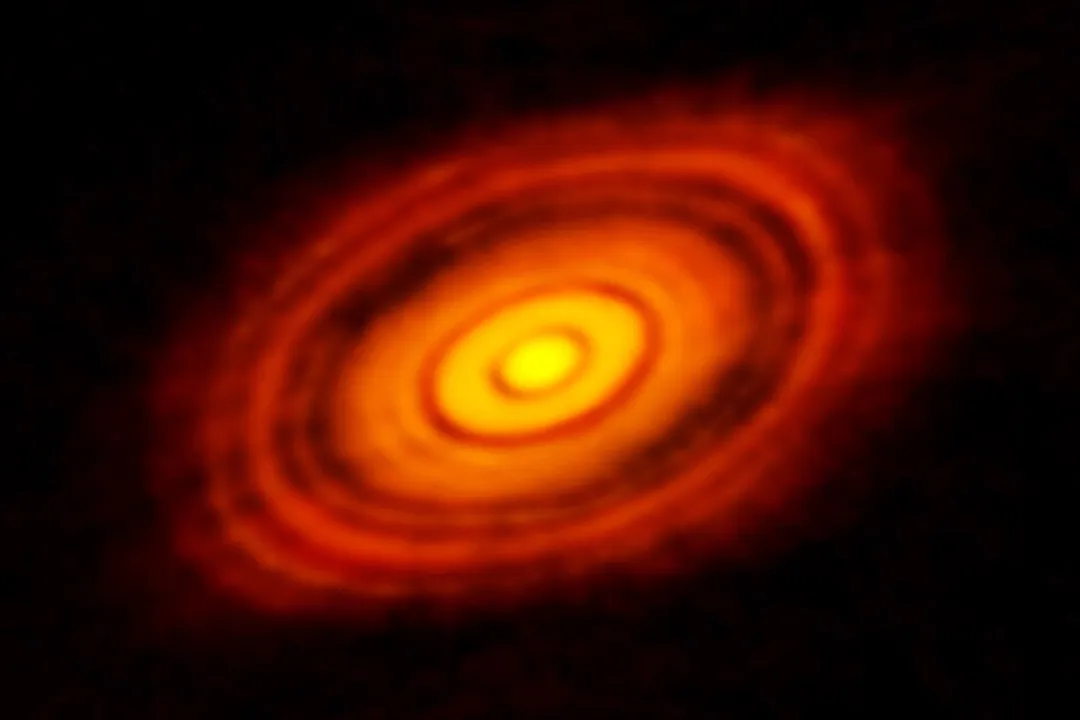
In astrophysics, accretion is the mechanism by which celestial bodies gain mass. [2] This process is essential for the formation of stars, planets, and galaxies. [2] It is fundamentally driven by gravity, the attractive force between masses. [7] Any particle of gas, dust, or even larger debris that strays too close to a massive object—like a forming star, a growing planet, or a black hole—will be pulled inward toward the center of mass. [2][7]
When discussing the birth of a star, accretion involves the slow gathering of surrounding interstellar gas and dust clouds onto the protostar at its center. [2] This steady feed of material is what allows the central object to reach the critical mass necessary to ignite nuclear fusion and become a true star. [2][7] Similarly, the initial stages of planet formation, known as core accretion, rely on smaller particles sticking together, gradually growing into planetesimals, and eventually the large rocky or gaseous planets we observe today. [2]
# Disk Dynamics
When matter falls toward a large central body, it rarely does so in a perfectly straight line. Because the initial material usually possesses some sideways motion or angular momentum, as it is drawn closer to the massive object, it begins to spin faster, much like a figure skater pulling in their arms. [7] This conservation of angular momentum forces the infalling material into a flattened, rotating structure known as an accretion disk. [2][7]
These disks are not static reservoirs; the material within them spirals slowly inward toward the center. This inward drift happens because of friction and turbulence within the disk itself, processes that effectively bleed off the angular momentum, allowing gravity to continue pulling the matter closer to the central body. [7] The continuous spiraling and collision of particles within the disk generate tremendous heat due to friction. [7] This friction is so intense that accretion disks surrounding objects like black holes or neutron stars can become incredibly luminous, emitting vast amounts of radiation across the electromagnetic spectrum, often outshining the central object they feed. [7] Understanding the exact rate at which material is transferred through this disk—often denoted as (the change in mass over time)—is vital because it directly dictates the final mass and eventual energy output of the accreting object, providing astrophysicists with a key parameter for stellar and galactic evolution models. [7]

# Earth Growth
Accretion is not limited to the vacuum of space; it is also a fundamental process in geology, where it describes the gradual accumulation of material onto a landmass or continent. [6] This geological accretion can happen in two primary ways: the slow deposition of sediment or the more dramatic addition of entire crustal fragments. [6]
Sedimentary accretion occurs when materials, such as sand, mud, or gravel, are carried by water—rivers, streams, or ocean currents—and deposited layer by layer along a shoreline or a riverbank. [6] Over immense stretches of time, these layers compact and lithify (turn to rock), gradually adding new material to the edge of the landmass. [6] This process can be quite slow, perhaps adding only a few centimeters per year, but its cumulative effect over millions of years can build up significant coastal plains or deltas. [9]
# Terrane Addition
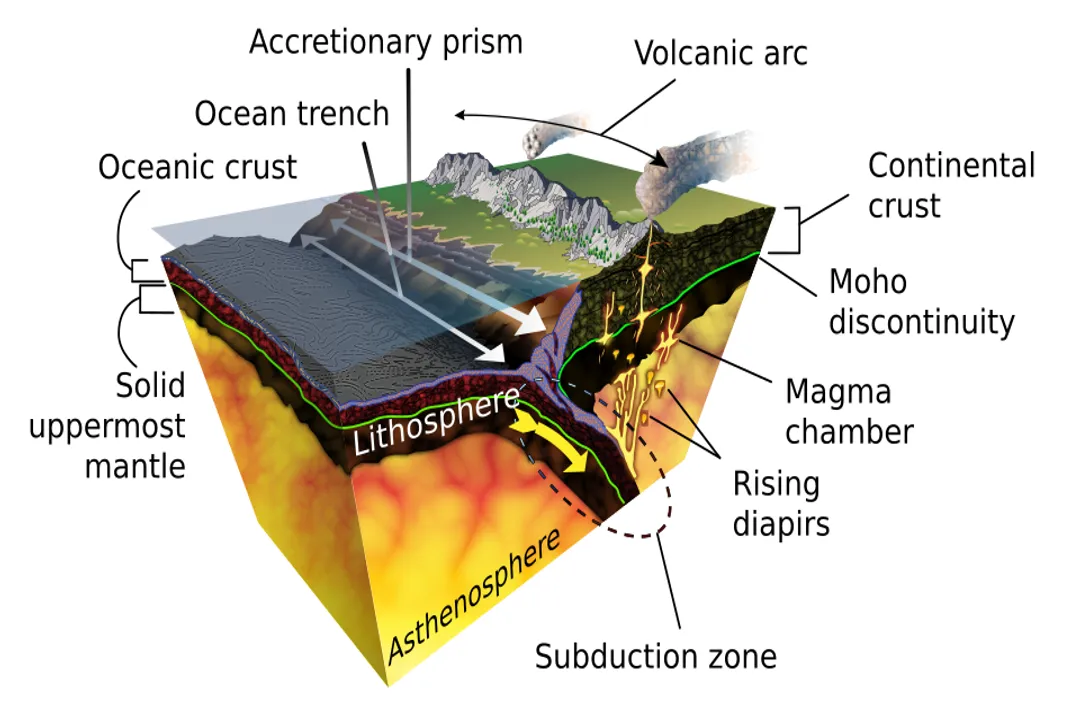
A more dramatic geological manifestation involves the addition of terranes. [5] A terrane is essentially a fragment of Earth's crust—perhaps an ancient seafloor, an oceanic island, or a piece of another continent—that has been scraped off a subducting tectonic plate and plastered onto the edge of a stationary continent. [5][6]
This process is intrinsically linked to plate tectonics and subduction zones. [5] When an oceanic plate collides with a continental plate, the denser oceanic plate sinks beneath the continent (subduction). [5] As the two plates grind past each other, the overriding continental plate acts like a bulldozer, scraping off softer or more buoyant material—like sedimentary rock or volcanic arcs—from the sinking plate and welding it onto the continent's edge. [5] The North Cascades in Washington State are a well-studied example where rock fragments from ancient oceanic environments were added piece by piece over time to build up the existing continental margin. [5] Geologists use specific terms for these accreted blocks, such as exotic terranes, to denote crustal blocks that have a distinctly different geologic history from the continent they are now attached to. [5]
| Accretion Type | Primary Mechanism | Typical Timescale | Observable Result |
|---|---|---|---|
| Astrophysical (Star/Planet) | Gravity drawing in gas/dust | Millions of years | Formation of a star or planet [2] |
| Geological (Sedimentary) | Deposition by water flow | Thousands to millions of years | Growth of coastlines, deltas [6][9] |
| Geological (Terrane) | Plate collision and scraping | Tens to hundreds of millions of years | Addition of new crustal blocks to continents [5] |
It is fascinating to consider that while the mechanics differ—one driven by classical Newtonian gravity in a vacuum, the other by the complex thermal and mechanical forces within the Earth's mantle—both the creation of a star system and the growth of a mountain range rely on the accumulation of material over long durations where the process of attachment is gradual rather than instantaneous. [2][5]
# Legal Interpretation
Beyond the natural sciences, the term accretion also finds definition within legal contexts, though its application is generally less frequent today for non-land-based scenarios. [9] In the law of property, accretion refers to the gradual and imperceptible accumulation of land due to the action of water. [9]
If a river or stream carrying sediment slowly deposits that material along its bank, the adjacent landowner gains that newly formed land as a property right because the addition was gradual and natural, not sudden. [9] This contrasts sharply with sudden events like avulsion, where a fast-moving flood dramatically changes a river's course or washes away a large section of land; in the case of avulsion, the original property line is generally maintained, whereas accretion results in a permanent change of boundary. [9] The key legal differentiator is the gradual nature of the change. [9]
# Comparing Scales and Forces
When looking across these disciplines—from the swirling gas around a black hole generating intense X-rays [7] to the slow deposition of silt by the Mississippi River [9]—the unifying theme is the accumulation of mass under specific physical constraints. In astronomy, the constraint is the spacetime curvature dictated by gravity, leading to the formation of a specific structure, the accretion disk, which then dictates the rate of mass transfer. [7] In geology, the constraint is the friction and rheology (flow properties) of rock under immense pressure, dictating which fragments are scraped off and welded onto a continent. [5]
An instructive way to view this is through the efficiency of accumulation. In an astrophysical setting, material spirals inward very efficiently once trapped by the disk, often leading to rapid mass increase for the central object relative to the total available material in the vicinity. [7] Conversely, geological accretion of a terrane is often a messy, inefficient process; much of the material scraped off might be deformed, buried deep into the subduction zone, or incorporated only partially into the continental margin. [5] Thus, while both processes build things up, the resultant structures carry fingerprints of the different physical environments they formed within—one dominated by extreme kinetic energy and radiation, the other by immense lithostatic pressure and thermal gradients. [5][7] The final product of accretion, whether a planet or a continental shelf, is a record of this patient, incremental attachment process. [1][6]
#Videos
What Is Accretion? - Physics Frontier - YouTube
Related Questions
#Citations
What is the process of accretion? | Quizlet
Accretion (astrophysics) - Wikipedia
Accretion Definition, Theory & Process - Lesson - Study.com
Accretion Processes - NASA ADS
Subduction and accretion - WA100
The physics of accretion: How the universe pulled itself together
accretion | Wex | US Law | LII / Legal Information Institute
[PDF] ACCRETION PROCESSES - arXiv
What Is Accretion? - Physics Frontier - YouTube