What was Pierre-Simon Laplace's theory?
The name Pierre-Simon Laplace echoes through the halls of classical physics and mathematics, representing a monumental figure whose work shaped our understanding of the universe from the smallest probabilities to the grand scale of celestial mechanics. Born in Normandy in 1749 and passing away in 1827, Laplace stood as a giant of the Enlightenment, making profound contributions across calculus, probability, and the study of planetary motion. [9][1] His theories provided a powerful, deterministic view of the cosmos, even as other areas of his work inadvertently contained seeds for later scientific revolutions.
# Life Overview
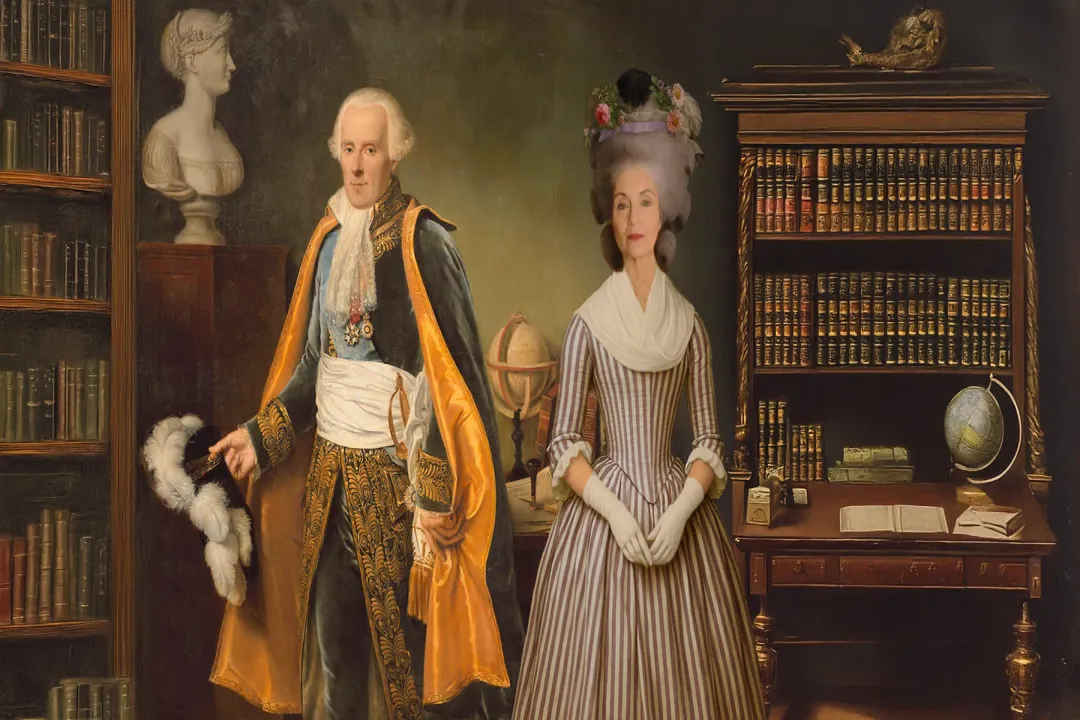
Laplace's career was characterized by extraordinary breadth and sustained productivity across several distinct scientific domains. [9] He was a brilliant mathematician who held positions of influence, especially following the French Revolution, serving in various governmental and educational capacities. [1] His mastery extended into areas as diverse as fluid dynamics, where his insights contributed significantly to the field, [8] and the formalization of probability theory, where he built upon the work of earlier thinkers to establish a more rigorous foundation. [1] This mathematical foundation was essential not only for his celestial mechanics but also for the philosophical implications of his most famous theoretical construct.
# Solar Formation
One of Laplace's most enduring contributions to cosmology is the Nebular Hypothesis, which offered a naturalistic explanation for the origin of the solar system. [2][5] This concept, often discussed alongside similar early ideas proposed by Immanuel Kant, suggested that the Sun and planets formed from a single, rotating cloud of gas and dust, a nebula. [3]
The proposed mechanism involved the nebula slowly cooling and contracting under its own gravity. [2] As it shrank, the conservation of angular momentum dictated that its rate of rotation must increase. This increased rotation caused the cloud to flatten into a disk shape, much like a spinning ball of dough flinging off pieces. [5] At the equator of this rapidly spinning, flattened mass, rings of material were successively shed. Each ring then coalesced, over time, to form a planet, while the remaining central mass became the Sun. [2][5]
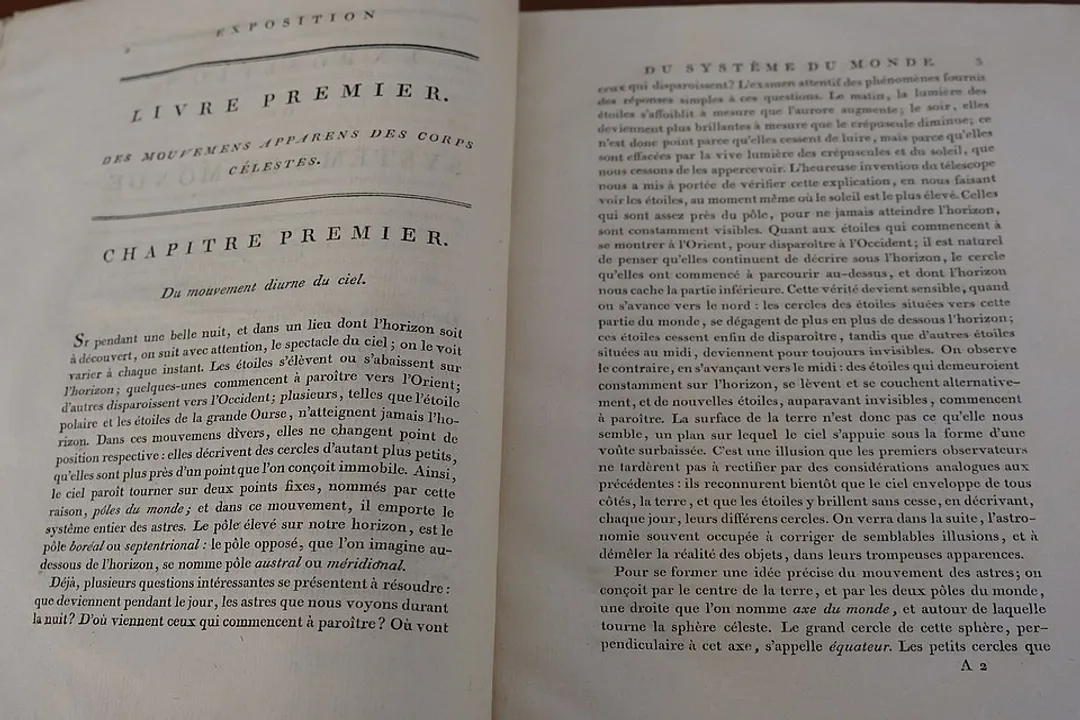
It is fascinating to note the historical context: Laplace published his primary formulation in the Exposition du Monde Céleste (System of the World) in 1796. [3] While Kant had suggested a rotating nebula earlier, Laplace provided a more detailed, mathematically grounded mechanical account for how the structure evolved. [3] The primary difference in emphasis often highlighted is that Kant focused more on gravitational instability acting on a pre-existing nebula, whereas Laplace meticulously detailed the process of centrifugal force causing the successive shedding of rings as the central mass contracted. [5]
While the broad concept of solar formation from a disk remains central to modern astrophysics—albeit with vastly more complex physics involving accretion, magnetic fields, and gravitational instability—Laplace’s original model had its limitations. For instance, the theory struggled to consistently account for the observed distribution of angular momentum, where the planets hold the vast majority of the solar system's rotational energy, despite the Sun containing nearly all its mass. [2] An astute reader might observe that Laplace’s model, relying purely on macroscopic rotation and centrifugal force, lacked the microscopic understanding of particle collision and momentum transfer that contemporary models incorporate, though its elegance provided a necessary conceptual leap at the time. [3]

# Laplace's Demon
Perhaps the most intellectually provocative concept associated with Laplace is the idea of Laplace's Demon, which encapsulates his belief in absolute determinism within the Newtonian framework. [4] This concept is best understood not as a literal entity, but as a thought experiment illustrating the implications of classical physics. [6]
The Demon posits that if an intellect—a "demon"—knew the precise location and momentum of every single particle in the universe at one instant, and understood all the forces of nature, that intellect could perfectly calculate both the entire past and the entire future of the universe. [3][4] In this view, every event, from the fall of a leaf to the orbit of a comet, is the inevitable, calculated consequence of prior states. [7] This perspective strongly suggests that the universe operates like a giant, perfectly predictable clockwork mechanism. [6]
This powerful idea beautifully complemented Laplace's success in celestial mechanics. He had managed to calculate planetary orbits with unprecedented accuracy, seemingly confirming that the heavens obeyed precise, knowable laws. [1] The Demon theory was, in many ways, the philosophical extension of this success: if the mechanics of a few celestial bodies are predictable, why not all mechanics?. [7]
However, the 20th century severely challenged the Demon's reign. The advent of quantum mechanics introduced inherent randomness at the fundamental level of reality. [4] Principles like Heisenberg's Uncertainty Principle suggest that it is physically impossible to simultaneously know both the exact position and the exact momentum of a particle, violating the Demon's necessary initial condition. [4] This shift implies that perfect prediction, even in principle, is unattainable for the fundamental constituents of matter, rendering Laplace's perfect determinism an incomplete picture of physical reality.
# Mathematical Depth
While the Nebular Hypothesis and the Demon capture the imagination, Laplace’s core expertise lay in the rigorous mathematical descriptions he developed. His work in probability theory, exemplified in his Théorie analytique des probabilités (1812), established techniques that remain fundamental in statistics today. [1] He introduced methods for approximating complex probability distributions, which were critical for analyzing errors in astronomical observations. [6]
Furthermore, his investigations into fluid dynamics provided crucial equations describing the behavior of ideal fluids, particularly concerning wave propagation and pressure distribution. [8] His work often involved solving complex differential equations, a necessity when modeling the motions of many interacting bodies in celestial mechanics. [1] The mathematical machinery Laplace constructed was so powerful that it became the standard tool for physical modeling for over a century, allowing scientists to move from descriptive accounts of nature to precise quantitative predictions. A practical exercise based on his probability methods, such as calculating the likelihood of observing a specific set of errors when measuring a planet's position multiple times, clearly demonstrates the power he brought to empirical science. [6]
# Lasting Impact
Pierre-Simon Laplace cemented his legacy as a figure bridging the gap between Newtonian mechanics and modern physical science. [9] His theories provided the mathematical backbone for predicting celestial movements for generations. [1] While quantum theory has since superseded the deterministic worldview upheld by the Demon, the methodology Laplace championed—the attempt to describe nature through precise mathematical laws—remains the defining characteristic of modern physics and engineering. [8] He provided the structure, even if later generations had to revise the fundamental occupants of that structure. [4] His pursuit of universal laws, whether applied to the birth of planets or the limits of knowledge itself, continues to inspire scientists grappling with the universe's vast complexities.
Related Questions
#Citations
Pierre-Simon Laplace
Pièrre Simon Laplace: The Nebular Hypothesis
Spooky Science: Laplace's Demon – Elements for Berkeley Lab
Kant-Laplace nebular hypothesis | astronomy
The Nebular Theory of Laplace Solar System
History of Probability (Part 5) – Laplace (1749-1827)
Laplace's Demon: An Interview Through Time
Pierre-Simon Laplace's Contributions to Fluid Dynamics
Pierre-Simon Laplace (1749 - 1827) - Biography