What is a transit method?

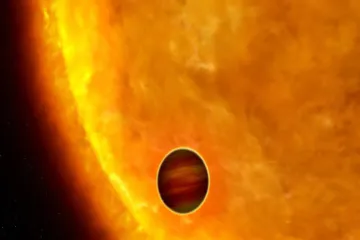
The way astronomers find worlds orbiting distant stars, known as exoplanets, often involves watching those stars very, very closely. The transit method, perhaps the most successful technique for confirming and characterizing these distant bodies, relies on a surprisingly simple, yet geometrically precise, observation: waiting for a planet to pass directly in front of its host star from our point of view. [1][7] When this alignment happens, the planet briefly blocks a tiny fraction of the star’s light, causing a measurable, though minuscule, dip in brightness. [2]
# Basic Principle

At its heart, the transit method is about observing these secondary eclipses. [7] Imagine looking at a distant streetlight from miles away. If a small insect were to fly directly between you and the bulb, the light would momentarily dim slightly before the insect moved on. Exoplanet detection works on the exact same principle, only the insect is a planet, and the streetlight is a star millions of light-years away. [2] This technique, often referred to as transit photometry, searches for periodic dips in stellar brightness that are consistent with an orbiting body moving across the star's face. [4] The method is one of the primary drivers behind the confirmed count of thousands of known exoplanets, especially small, rocky worlds orbiting close to their stars. [5]
# Signal Detection

The key to this work is photometry, which is the precise measurement of light intensity. [4] Telescopes specifically designed for this purpose monitor the light output of thousands of stars simultaneously, recording their brightness over weeks, months, or even years. [4][5] This record of brightness over time generates what astronomers call a light curve. [1] A successful detection shows up as a characteristic, U-shaped or box-like dip in the light curve, representing the transit event. [1]
The challenge lies in the scale of the dimming. For a Jupiter-sized planet transiting a Sun-like star, the brightness drops by only about 1 percent. [2] If the planet is Earth-sized, transiting a Sun-like star, the drop is closer to just 0.008 percent, or about 80 parts per million. [2] This minuscule change means that detection requires incredibly stable instruments and long observation periods to distinguish a real planetary signature from stellar noise, instrumental jitter, or background stars blending their light together. [4]
# Data analysis
Once a recurring dimming event is detected, scientists move to analyze the resulting light curve to extract physical details. [1] The shape and depth of the dip provide the first major clues. The depth of the transit—how much the light dims—is directly proportional to the ratio of the area of the planet to the area of the star. [1][7] This relationship allows astronomers to determine the radius (size) of the transiting planet, provided they have a good estimate of the star's radius. [1]
The duration of the transit and the time between successive dips (the orbital period) tell us about the orbit itself. A shorter period means the planet is orbiting closer to the star. [1] By combining the orbital period with Kepler's Third Law of Planetary Motion, astronomers can calculate the planet's average distance from its star, known as the semi-major axis. [1]
It is interesting to consider the statistical purity of this signal when viewed against other methods. Because the transit method is so sensitive to size, it excels at finding smaller worlds, even if the star itself is relatively small. However, it entirely misses planets that orbit farther out or those that are orbiting their star in a plane that does not intersect our line of sight. This creates an inherent observational selection effect that must be carefully accounted for when building models of planetary populations; we are only seeing the "edge-on" planetary systems. [5][6]
# Derived properties
The transit method yields critical geometric and size information, but it doesn't directly measure the planet's mass. [5] To get the mass, astronomers typically need to combine transit observations with data from another technique, most commonly the radial velocity method (which detects the star's gravitational wobble). [5] When you combine the mass (from radial velocity) and the radius (from transit), you can calculate the planet's density. [5] Density is a fundamental property that offers insight into a planet’s composition—for instance, whether it is primarily rock, gas, or ice. [5]
For example, if a planet is found to have a radius similar to Earth's but a density close to that of water, we can infer it is a water world or possesses a very thick atmosphere. [5] Missions like NASA’s Kepler and TESS (Transiting Exoplanet Survey Satellite) have been wildly successful because they prioritize finding these size measurements across large statistical samples of stars. [3] Future observatories, such as the Nancy Grace Roman Space Telescope, are specifically being designed to conduct wide-field transit surveys to find Earth-sized planets orbiting in the habitable zones of Sun-like stars. [3]

# Orbital alignment
The biggest hurdle in the transit method is the necessity of near-perfect orbital geometry. [1] For a transit to occur, the planet’s orbital plane must pass precisely through the line connecting the star and Earth. [1] This alignment requirement is extremely stringent. For a planet orbiting a star very much like our Sun, there is only about a half-percent chance that its orbital inclination will be close enough to perfectly align for us to witness a transit. [1]
This geometric constraint means that the transit method is inherently biased toward finding planets with short orbital periods—those that orbit close to their stars. A planet with a 500-day orbit has many more opportunities per year to align correctly than a planet with a 10-day orbit, but the 10-day planet completes many transits while we might only catch one or two of the long-period planet's transits, if we are lucky enough to be observing at the right time. [1] If a system’s plane is tilted even a few degrees relative to our view, the planet will appear to pass slightly above or below the star, and no dimming signal will be registered. [5]
# Method comparison
Understanding the transit method is best achieved by contrasting it with its main counterpart: the radial velocity (Doppler spectroscopy) method. [5]
| Feature | Transit Method (Photometry) | Radial Velocity Method (Spectroscopy) |
|---|---|---|
| What is measured | Decrease in star's brightness | Shift in star's spectral lines (Doppler shift) |
| Primary Result | Planet Radius (Size) | Planet Mass |
| Requirement | Orbital plane must be edge-on to Earth | Star's gravitational tug must be detectable |
| Bias | Favors short-period orbits | Favors large-mass planets orbiting close to the star |
When both methods successfully identify the same planet, the resulting data set is far richer, allowing for the calculation of mean density and better compositional inferences. [5] The radial velocity method, for example, is sensitive to the mass of the star and the wobble it causes, which is independent of orbital orientation, though it cannot easily measure the size of the planet itself. [6] The transit method is often easier to apply to larger samples of stars because the required precision for brightness measurement is often technically less demanding than the extremely fine spectral measurements needed for the radial velocity technique. [5]

# Challenges faced
Even when an alignment seems perfect, identifying a true exoplanet is not guaranteed. A major difficulty in transit surveys is ruling out false positives. [4] The most common false positive scenario involves an eclipsing binary star system where two stars orbit each other, and we are seeing one star eclipse the other, mimicking a planetary transit signal. [4] Other sources of false positives can include starspots, flares, or background eclipsing systems whose light is blended with the target star. [4] Distinguishing these genuine eclipses from planetary transits often requires detailed follow-up observations using radial velocity measurements to confirm the orbital path and mass constraints. [4]
Another practical difficulty is the faintness of signals from small planets orbiting distant, faint stars. While TESS observes the nearest and brightest stars, ground-based follow-up observations still require large telescopes to achieve the necessary precision for smaller targets. [4] The longer the orbital period, the longer the required observation time to see a second transit and confirm periodicity, which is a significant logistical hurdle for characterizing giant planets that might take years to complete one orbit. [1]
#Videos
How to Detect EXOPLANETS - The Transit Method - YouTube
Related Questions
#Citations
What's a transit? - NASA Science
Transit Method - Las Cumbres Observatory
Down in Front!: The Transit Photometry Method | The Planetary Society
Methods of detecting exoplanets - Wikipedia
The Transit Method of Detecting Exoplanets | PBS LearningMedia
What is the Transit Method? - Universe Today
How to Detect EXOPLANETS - The Transit Method - YouTube
Transiting Planet Resources in the Exoplanet Archive
Transit Photometry as an Exoplanet Discovery Method - NASA ADS