Why does it seem darker at night?

The immediate reason the world around us appears darker at night is straightforward: our particular location on Earth has rotated away from the Sun. [9][4] Night is defined as the period when a specific region of the globe is shielded from direct sunlight by the planet itself. [9] This transition from day to night involves an immense drop in luminous energy reaching our eyes because the Sun is overwhelmingly brighter than any other light source visible from our vantage point. [4]
# Solar Blocking
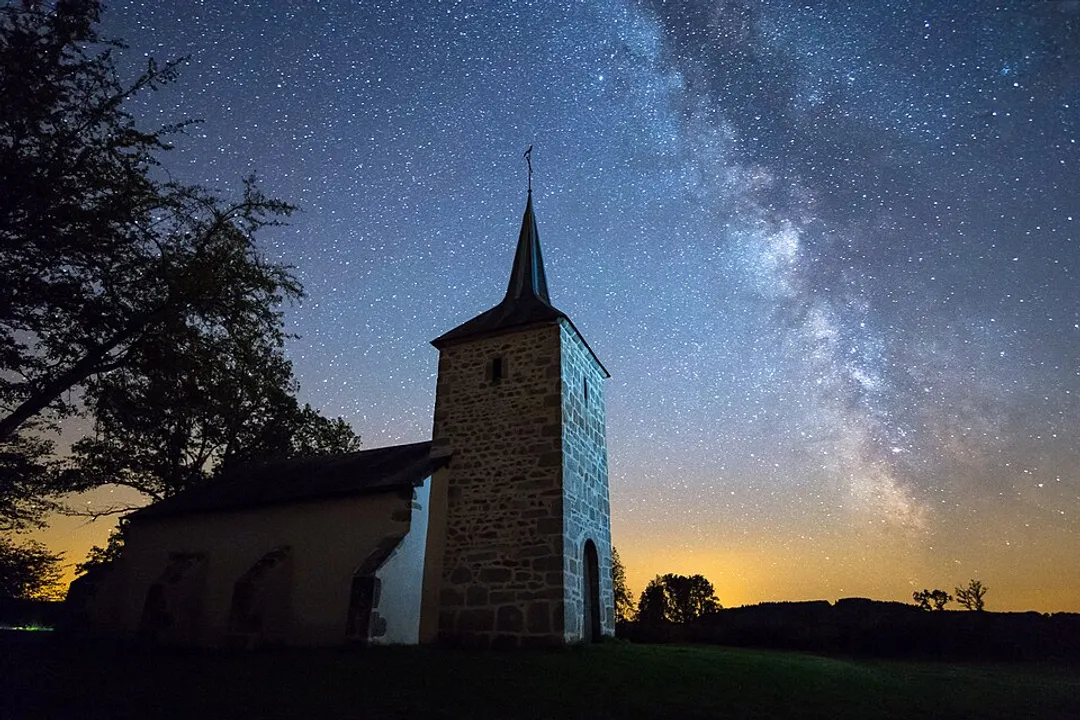
The power difference between our star and the next nearest star is staggering, which explains the severity of the change we perceive. During the day, the Sun bathes our hemisphere in radiant energy. [4] When the Earth spins, that hemisphere is plunged into shadow, and we look out into space, where the only illumination comes from distant stars, galaxies, and faint background radiation. [6] Even though there are billions of stars in the sky, the amount of light they provide collectively is negligible compared to that single, nearby star. [4]
To give this disparity some context, consider the photon flux. The energy striking an object directly facing the Sun is immense. If we compare the light received from the Sun, which is about 8 light-minutes away, to the light from Proxima Centauri, the closest star at roughly 4.24 light-years away, the difference in brightness is vast enough that Proxima Centauri is invisible to the naked eye, despite being comparatively close on a cosmic scale. [6]
| Light Source | Relative Distance (Approx.) | Visible Brightness Impact | Dominant Factor at Night? |
|---|---|---|---|
| The Sun | 8 Light-Minutes | Overwhelming day source | No |
| Proxima Centauri | 4.24 Light-Years | Faint, only visible with aid | Minimal |
| Midday Sky | N/A (Atmospheric Effect) | Maximum diffuse brightness | No |
| Clear Night Sky | N/A (Starlight) | Near darkness (minus airglow) | Yes |
# Scattered Light
The perception of darkness is also tied to what happens to light during the day. The daytime sky is not actually black because of an optical phenomenon involving our atmosphere. [1] Sunlight interacts with the gases and tiny particles suspended in Earth's air, a process known as Rayleigh scattering. [1] This scattering redirects sunlight across the entire sky, making the whole dome appear bright blue, even in directions away from the Sun. [1] This pervasive scattering creates a high baseline of ambient light during the day.
At night, however, this mechanism ceases to function as the primary illuminator. When the Sun sets, the direct light source is blocked, and there is no significant energy left to scatter across the atmosphere in the way it does during the day. [4] What remains is the extremely faint light originating from distant celestial bodies, which travels through the near-vacuum of space before hitting our atmosphere, resulting in a much lower, more diffuse level of illumination. [6] The contrast between the sunlit hemisphere and the unlit hemisphere is what makes the night feel so profoundly dark in comparison. [1]
# Paradox Resolved
If you consider the universe in the way 19th-century thinkers did—as an infinite expanse, uniformly filled with static stars that have existed forever—the darkness of the night sky presents a profound conundrum known as Olbers' Paradox. [6] Logically, if the universe were infinitely large and eternal, every line of sight should eventually end on the surface of a star, meaning the entire night sky should glow as brightly as the surface of the Sun. [2][6]
The fact that the sky is dark confirms that one or both of those assumptions must be wrong. [6] Modern cosmology tells us the universe is not infinitely old; it began approximately 13.8 billion years ago. [2] This finite age is the key resolution to the paradox. [2][6] Light from the most distant stars and galaxies simply hasn't had enough time to reach us yet. [2] Furthermore, the universe is expanding, meaning that the light from distant objects is redshifted, stretching its wavelengths toward the invisible infrared spectrum, further reducing its perceived brightness in the visible range. [2][6] The darkness of space is therefore an indication of the universe's origin in time and its dynamic expansion. [6]
# Faint Glow
While the night sky is overwhelmingly dark compared to daylight, it is not completely devoid of light. There are several components that contribute to the faint background luminescence observed even on the clearest nights away from civilization. [8] One component is the collective light from all the stars and galaxies whose light has reached us over cosmic time. [6] This starlight, while faint, is constant. [8]
Another natural phenomenon contributing to this residual darkness is airglow. [8] This is a very weak emission of light by the Earth's own atmosphere, caused by various chemical reactions, such as the recombination of atoms that were split by solar radiation during the day. [8] Airglow is always present, even in the absence of the Moon or artificial light. [8]
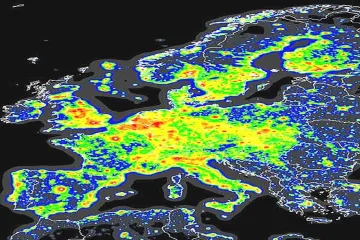
In practice, however, the perceived darkness for most people is far from this fundamental celestial limit due to human activity. Light pollution from cities and towns washes out the fainter stars and even the Milky Way. [8] This localized, artificial light pollution dramatically reduces the contrast between the background sky and any faint natural source, making the night appear less dark than it would be in a truly isolated location. [8] For instance, in a major metropolitan area, the sky brightness can be hundreds of times higher than the natural, unpolluted background glow.
# Dawn Approaches
The darkness deepens and lightens in predictable patterns relating to the Sun's geometry relative to our horizon. Just before sunrise, the sky begins to brighten noticeably, moving from astronomical twilight into nautical and then civil twilight. [9] This pre-dawn brightening is a direct consequence of the Earth's rotation bringing the Sun back into view, causing the upper atmosphere to catch the Sun's rays before the direct light hits the observer. [5] Astronomers note that the absolute darkest period, often considered the deepest part of the night, occurs during the middle of the night, far from the setting and rising events. [5] The absolute darkest moment before dawn is when the Sun is at its furthest point below the horizon, just before the increasing atmospheric scattering signals the end of true night. [5]
The experience of darkness is thus a layered reality. On the most basic level, it is caused by the Earth blocking our local star. [4] On a deeper, physical level, it is confirmed by the finite age of the cosmos, which prevents the entire sky from being saturated with ancient starlight. [2][6] Finally, our immediate environment dictates the quality of that darkness, as local human illumination can easily mask the true, faint glow of the universe. [8]
#Videos
Why is it Dark at Night? - YouTube
Related Questions
#Citations
Why does my room seem darker during the hours prior to sunset ...
Why Is The Sky Dark At Night? - Medium
Why is it Dark at Night? - YouTube
Why Does It Get Dark At Night - The Average Scientist
Is the night really darkest just before the dawn? If so, why? - Quora
Why is the night sky dark? - Astronomy Magazine
What causes space and the night sky to appear dark - Britannica
How Dark Is the Night Sky? | Scientific American
Night - Wikipedia
Why do stars appear dimmer in the evening and morning, and ...