Who is the father of rockets?
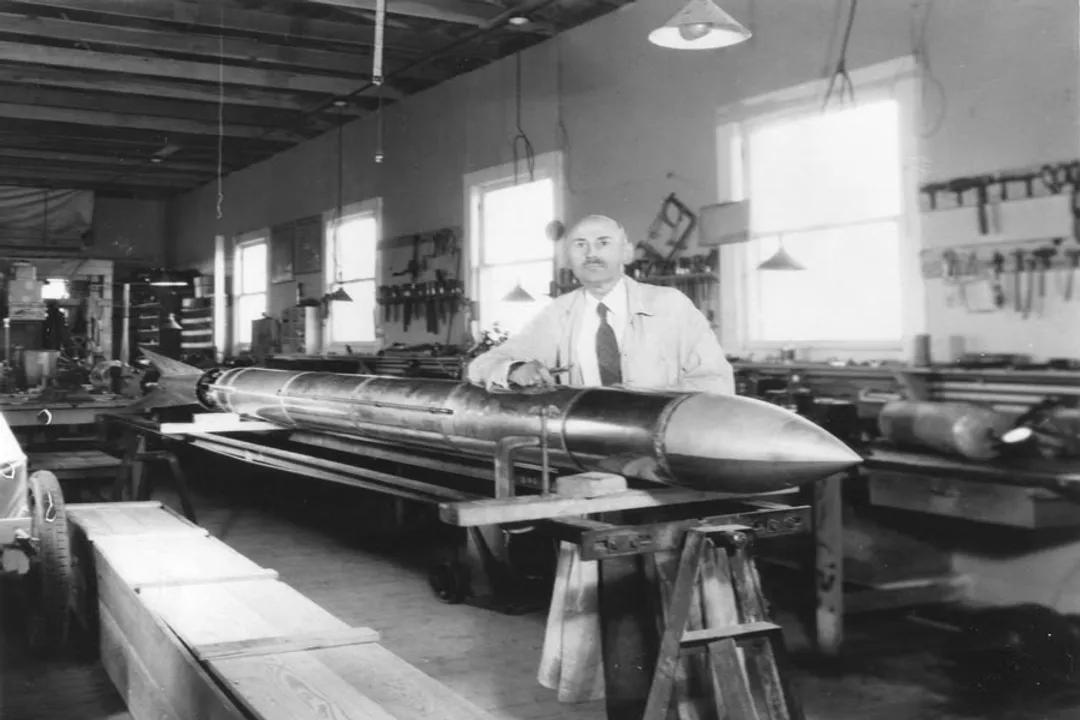
The figure most widely celebrated as the father of modern rocketry is Dr. Robert H. Goddard. This American pioneer dedicated his life to developing the technology that would eventually define space exploration. His foundational work, often conducted away from widespread public acclaim, laid the necessary scientific and engineering groundwork for the powerful rockets of later eras.
# Pioneer's Start

Robert Hutchings Goddard was born in 1882. His education began in earnest at Worcester Polytechnic Institute (WPI), where he earned his bachelor's degree in 1904. Following his undergraduate studies, he continued his academic pursuits, earning a master's degree from Clark University in 1906 and a Ph.D. in physics from Clark University in 1911. These academic foundations provided the theoretical basis for his practical experimentation.
After completing his formal education, Goddard took up teaching positions, instructing at both Clark University and Worcester Polytechnic Institute. While teaching was his vocation, his true passion remained the development of rockets—specifically, moving beyond the theoretical limits of solid fuels to unlock the potential of liquid propellants.
# First Liquid Launch
The defining moment in Goddard’s experimental career occurred on March 16, 1926. On this historic day in Auburn, Massachusetts, Goddard successfully launched the world's first liquid-fueled rocket. This achievement was monumental, as liquid fuel offered vastly superior performance and controllability compared to the solid motors used previously. The rocket, though modest in scale, demonstrated the core principles of modern rocketry. The launch site for this breakthrough was on his Aunt Effie's farm in Auburn.
Goddard's pioneering work was not limited to just igniting the engine. He was instrumental in developing several key components essential for modern spaceflight systems. These included the initial design for liquid-fuel rocket engines and the concept of multi-stage rockets—a necessary technique for achieving high altitudes or orbital velocity. Furthermore, he developed the first gyroscope specifically designed for guiding rockets, addressing the critical problem of stability during powered flight.
The technical advancements he achieved were protected through intellectual property rights. Goddard received patents for his innovations, including those for liquid-fuel rocket engines and rocket guidance systems. This focus on patenting his work, long before the technology was widely accepted, served as an early, perhaps unintentional, defense of his revolutionary concepts against a skeptical public and scientific community. Protecting these ideas was crucial, as the realization of their value took decades.
# Public Skepticism
The radical nature of Goddard’s goals—to send rockets to the upper atmosphere and even the Moon—often placed him at odds with public and even established scientific opinion of the time. He experienced considerable ridicule for his theories and experiments. This pervasive lack of support and understanding often compelled him to work with a degree of secrecy, seeking quiet support where he could find it.
This early 20th-century environment provides an interesting contrast to later rocketry efforts. When engineers like Wernher von Braun began their work, particularly in Germany, they often did so under the massive, centralized financial and material backing of a state entity focused on military application. Goddard, conversely, was largely self-funded or supported by small grants, such as those from the Smithsonian Institution, and had to prove the basic physics of liquid propulsion to a largely unconvinced world. It required immense personal conviction to continue this work when the immediate payoff or public validation was absent.
| Achievement Area | Goddard's Contribution (Early 20th Century) | Implied Later Context (Post-WWII) |
|---|---|---|
| Propulsion | First successful liquid-fueled rocket launch | Large-scale liquid-fueled ballistic vehicles |
| Guidance | Developed the first rocket gyroscope system | Sophisticated inertial guidance systems |
| Structure | Patented multi-stage rocket concepts | Essential for reaching orbital velocities |
| Reception | Faced ridicule and worked in relative secrecy | Heavy state sponsorship and focus |
The fact that Goddard's crucial 1926 launch was not immediately heralded as the start of a new age speaks volumes about the gap between theoretical science and public acceptance of paradigm-shifting technology.
# Institutional Support
While public opinion was often dismissive, Goddard secured vital institutional backing that allowed his research to continue, particularly through the Smithsonian Institution. Partnerships like this provided the necessary, albeit sometimes limited, resources and credibility for his continued experiments. His work was recognized by institutions that saw the long-term potential in his mathematical and engineering proofs.
His association with the Smithsonian helped foster his endeavors, allowing him to push the boundaries of what was considered possible in rocketry during that time. This type of long-term, foundational support is often necessary for truly revolutionary science that doesn't yield immediate, easy-to-understand results.
# Lasting Impact
Dr. Robert H. Goddard passed away in 1945. However, the seeds he planted—the liquid-fueled engine, the staged concept, and the guidance systems—blossomed in the decades following his death. His contributions are considered the bedrock upon which the massive advancements in rocketry and space exploration that followed were built.
The successful development of liquid-propellant rockets was a direct enabler for all subsequent large-scale space programs. Without the proof of concept and the fundamental engineering established by Goddard, the path forward for figures like Wernher von Braun and the subsequent Cold War space race would have been significantly longer and more uncertain. Goddard’s early patents and successful small-scale launches proved that space travel, as an engineering problem, was solvable.
Considering the current state of aerospace engineering, it is fascinating to note that the physics governing his 1926 liquid rocket—thrust, mass flow, specific impulse—remain the same core challenges today, albeit scaled up by orders of magnitude. Any modern launch vehicle designer, even those working on reusable first stages, fundamentally relies on the principles Goddard proved possible with a small device launched in a Massachusetts field. His legacy is not just historical; it is fundamentally embedded in the operational reality of every rocket launched since.
# A Final Word
The title of "father of rocketry" is an acknowledgment that one individual synthesized disparate scientific ideas into a working machine that changed the trajectory of human endeavor. For Goddard, this meant moving from paper concepts to tangible, roaring proof that liquid-fueled flight was viable, despite years of skepticism. His work represents a triumph of persistence in the face of prevailing scientific skepticism, ensuring that the first steps into the age of rocketry were taken by an American pioneer.
#Videos
The Story of Robert Goddard, Father of Modern Rocketry - YouTube
Related Questions
#Citations
Robert H. Goddard - Wikipedia
Dr. Robert H. Goddard, American Rocketry Pioneer - NASA
Robert Goddard | Auburn, MA
Dr. Robert Hutchings Goddard (1882-1945) is considered the father ...
Robert Goddard, Father of Rocketry | National Postal Museum
Robert Goddard | Worcester Polytechnic Institute
Dr. Robert H. Goddard - Air Force Museum
The Story of Robert Goddard, Father of Modern Rocketry - YouTube