Newton law articles

What is the fundamental mathematical equation summarizing Newton's second law of motion?
If the mass of an object is kept constant, how is the applied force related to the resulting acceleration?
What does the 'F' in the equation F = ma specifically represent in physics?
If the net force acting on an object is zero, what is the resulting acceleration?
How is acceleration related to mass when the applied force is kept constant?
In which direction is the resulting acceleration always directed according to Newton's second law?
How is one Newton (1 N) formally defined in terms of standard SI units for mass and acceleration?
What property of matter does mass describe concerning changes in motion?
In terms of momentum ($ ext{p}$), how is force originally stated to be proportional?
Why is the momentum form of the second law essential for analyzing rocket propulsion?
How do seatbelts or airbags function to make impacts safer, based on the momentum perspective?
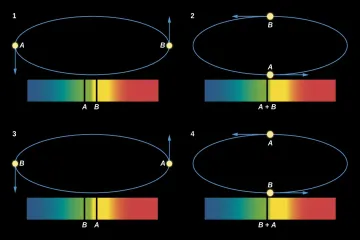
What system configuration is used by astronomers for the most direct method of weighing stars?
What physical law, in its general form, connects the sum of the masses to the orbital period and semi-major axis in a binary system?
When using standard astronomical units ($P$ in years, $a$ in AU), what quantity does the equation $(M_1 + M_2) = a^3 / P^2$ yield directly?
In a binary system, how is the mass ratio $\frac{M_1}{M_2}$ determined based on the distances from the center of mass ($a_1$ and $a_2$)?
If an orbital plane is tilted by an angle $i$ relative to the line of sight, what value represents the observed, foreshortened semi-major axis?
What concept arises because the unknown inclination $i$ causes the mass equation to depend on $a^3$?
If an astronomer calculates a minimum mass for an unseen companion that exceeds $3 M_ ext{sun}$, what is strongly suggested about that unseen object?
How are orbital motions detected in Spectroscopic Binaries?
For Eclipsing Binaries, why is the mass calculation generally more direct and accurate?
What two conservation laws underpin the physics validating the Newtonian form of Kepler's Third Law in two-body orbits?
What observational method produces a light curve by monitoring the total light from a system?
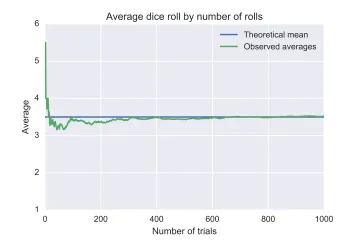
What does the Law of Large Numbers formally dictate regarding the average of outcomes?
What type of random variables is the formal definition of the LLN based upon?
How does the variance of the sample average, $\text{Var}(\bar{X}_n)$, change relative to the sample size ($n$)?
What mode of convergence does the Weak Law of Large Numbers (WLLN) guarantee?
What does the Strong Law of Large Numbers (SLLN) assert about the sequence of sample averages?
Which statement accurately describes the mathematical relationship between the Strong Law and the Weak Law?
What specific notion does the Gambler's Fallacy incorrectly suggest regarding random events?
What does the LLN smooth out regarding the observed results of a fair coin flip over many trials?
How does the LLN benefit an insurance company dealing with individual policyholders?
Under which condition regarding the underlying distribution will the sample mean *not* converge to a single finite value according to the LLN?