Is there Stardust in people?
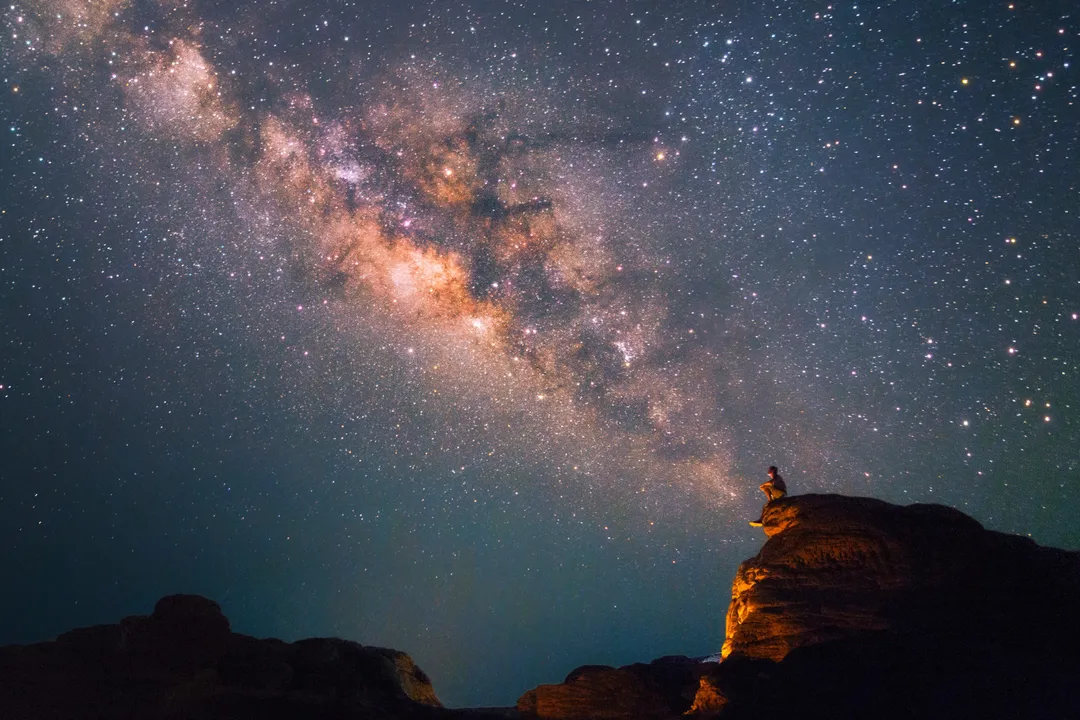
The very material that constitutes our bodies—the carbon in our bones, the oxygen we breathe, the iron powering our blood—was forged in the violent deaths of long-vanished stars. [3][7][8] This isn't merely poetry; it is a description of physical reality rooted in stellar nucleosynthesis. Every atom heavier than lithium on Earth, and consequently in every living thing on it, originated somewhere else in the cosmos before being recycled into our solar system. [3]
# Cosmic Origins

The story begins shortly after the Big Bang, which primarily created the lightest elements: hydrogen and helium. [3] For any element beyond these two—the building blocks of life as we know it—an immense amount of energy and pressure is required to smash atomic nuclei together until they fuse into heavier ones. [7] This massive energy source is found only within stars.
Stars spend the majority of their lives in a stable phase, fusing hydrogen into helium in their cores. [3] However, when massive stars exhaust their fuel, their cores collapse, leading to one of the universe's most spectacular events: a supernova explosion. [3][8] These explosions are essential for the creation and distribution of heavier elements. [3]
During the intense heat and pressure of a supernova, elements like oxygen, carbon, nitrogen, and even iron are synthesized. [3] When the star finally detonates, it blasts these newly created materials across interstellar space. [3] This enriched cosmic dust then mixes with primordial hydrogen and helium clouds, eventually collapsing under gravity to form new generations of stars, planets, and asteroids—the raw material for Earth. [3] The concept, often associated with astronomer Carl Sagan, is that we are intimately connected to the remnants of these stellar furnaces. [8]
# Atomic Inventory

To grasp the "stardust" concept fully, one must examine the elemental composition of a human being. [7] While the universe itself is overwhelmingly hydrogen and helium, the human body concentrates elements that require stellar processing. [2]
Consider water (), which makes up a significant portion of our mass. Hydrogen is primordial, but oxygen requires stellar fusion. [7] Carbon, the backbone of all organic life, is also a product of star life, created by fusing helium nuclei within stars that are not massive enough to reach supernova status, or through later stages of fusion in larger stars. [3]
A common discussion arises regarding the exact percentage of "stardust." Some analyses suggest that roughly 97 percent of the atoms making up the human body come from stellar processes. [5] These elements include critical components like calcium, potassium, and the essential iron found in hemoglobin, which binds and carries oxygen throughout our blood. [3][8]
If we account for the major elements—Oxygen (), Carbon (), Hydrogen (), and Nitrogen ()—we account for over 96% of the body's mass. [5] Hydrogen is the exception, being primarily from the Big Bang, though it is incorporated into water molecules forged or processed through stellar activity. [5] The remaining fraction, often cited around 3%, comprises elements like calcium, phosphorus, and trace minerals, all of which trace their origins back to stars or supernovae. [5] The distinction often rests on semantics: is the hydrogen in our water "stardust," or only the heavier elements? Scientifically, the vast majority of the mass and complexity that defines us required stellar furnaces to assemble. [3][7]
# Element Generation Differences
It is helpful to think of the elements not as a single batch but as different products from different types of stellar events. [3]
| Element Group | Primary Origin Event | Role in Human Body |
|---|---|---|
| Hydrogen, Helium | Big Bang | Mostly found in water (Hydrogen component) |
| Carbon, Oxygen, Nitrogen | Fusion in lower-mass stars, later ejected | Primary organic building blocks, respiration |
| Iron, Nickel | Massive Star Core Fusion, Supernova | Oxygen transport (hemoglobin), structural support |
| Gold, Uranium | Supernovae or Neutron Star Mergers | Trace minerals |
The iron in your red blood cells is a particularly compelling example. It could not have formed in a star like our Sun; it required a much larger star to live fast and die dramatically, scattering the element across the galaxy. [3]
# Stellar Chemistry
The process of building these elements inside stars is known as nucleosynthesis, and it dictates which materials are available for planetary formation. [7] For general readers, visualizing the difference between the creation of a light element versus a heavy one clarifies the scale of cosmic recycling required for human existence.
For instance, creating carbon and oxygen happens relatively smoothly in stars several times the mass of our Sun. [3] These elements are built up over millions of years before the star puffs them out gently in a planetary nebula, or they are dispersed when the star dies. [3]
Contrast this with the elements heavier than iron. Fusion processes within a star actually consume energy when trying to create elements heavier than iron, meaning the star cannot sustain itself by making them. [3] Therefore, these extremely heavy elements—like gold, silver, or even iodine in our thyroids—must be created during the instantaneous, violent energy burst of a supernova explosion or the collision of neutron stars. [3] This suggests that the trace elements in our bodies are derived from the universe's most energetic and rare catastrophic events.
This distribution mechanism means that the elements that make up you and me were scattered across the Milky Way over billions of years, potentially existing inside multiple previous stellar generations before finally condensing into the cloud that formed the Sun approximately $4.6$ billion years ago. [3] The atoms comprising your left hand might have been synthesized in a different star billions of years ago than the atoms in your right hand, an interesting perspective to adopt when considering daily tasks like gripping a coffee mug. Think of the local environment: the elements necessary for building terrestrial planets are far more concentrated in areas of the galaxy that have experienced multiple cycles of star birth and death, which is why Earth exists where it does, rather than closer to the galactic center where radiation is higher, or in the outer halo where enrichment is lower.
# Journey Time
Understanding that we are stardust is profound, but understanding when this happened adds context to our existence. The term "stardust" often implies a single, recent event, but the timeline spans eons. [3]
Our solar system formed about $4.6$ billion years ago. [3] The earliest known evidence of life on Earth dates back at least $3.5$ billion years, though some microbial evidence hints at older origins. [7] This leaves a significant gap—over a billion years—between the formation of the stellar material clouds and the emergence of the first life forms capable of utilizing those materials.
This time gap is crucial because those heavy elements needed time to settle into interstellar dust grains, clump together, and form the building blocks of our solar system. The process isn't instantaneous recycling. The first stars formed and died relatively quickly, but the process of creating a stable, rocky world with water and a sustained atmosphere, capable of supporting complex chemistry, took much longer. If we trace the path of a single carbon atom in your body, it might have spent hundreds of millions of years inside a progenitor star, another few hundred million years as free-floating interstellar dust, and then perhaps a billion years locked inside a meteoroid before finally becoming part of an ocean molecule on the early Earth.

# Personal Connection
Accepting that we are physically constructed from stellar debris offers a shift in perspective, moving the abstract concept of cosmology into the tangible reality of the body. [2] It means that the iron responsible for transferring oxygen to your cells is chemically identical to the iron forged in a dying star millions of light-years away and billions of years ago. [8]
For a simple, actionable thought exercise, consider your next meal of leafy greens or a piece of meat. Nearly every atom—the carbon backbone, the oxygen in the water, the trace copper—was assembled under conditions far more extreme than anything on Earth’s surface today. [7] When you eat, you are not just consuming calories; you are physically integrating the debris of ancient celestial mechanics. This highlights a fundamental dependency: without the deaths of massive stars, the chemistry required for your current existence simply would not be present in this localized region of the galaxy. This reinforces the idea that the processes that destroy stars are inherently creative for planetary systems. [3] We are, quite literally, the result of celestial recycling on a cosmic scale.
#Videos
Are we made of stardust? | Surprising Science - YouTube
Related Questions
#Citations
A question about humans and us being stardust. : r/askscience
Are We Really Made of Stardust? | Psychology Today
Humans Really Are Made of Stardust, and a New Study Proves It
Are we made of stardust? | Surprising Science - YouTube
The Connection Between Humans and Star Dust - Facebook
If 97% of the human body is made of stardust, what about ... - Quora
Humans Really Are Made of Stardust
Dr Karl: Yes, humans are stardust - Australian Geographic
How Are We Made of Star Stuff? We Asked a NASA Expert: Episode ...