What did Stephen Hawking predict before he died?

The world paid close attention to the final pronouncements of Stephen Hawking, the theoretical physicist whose insights reshaped our understanding of space and time. Just weeks before his passing in March 2018, Hawking shared thoughts that touched upon the fate of the cosmos and the immediate dangers facing humanity. His legacy, captured partly in the posthumously published collection Brief Answers to the Big Questions, revealed a continued focus on existential threats and the deepest mysteries of physics.
# Cosmic End

One of the most discussed topics in Hawking’s final days concerned the ultimate fate of the universe itself. This discussion centered on his lecture, often framed as "The End of the Universe," which delved into the concept of eternal inflation.
Hawking explained that eternal inflation suggests our universe is not a singular event, but rather one of countless "bubble universes" constantly budding off from an ever-expanding background spacetime. In this model, the expansion never truly stops everywhere; it only stops in localized regions, like our own universe, allowing structures like stars and galaxies to form. The implication is that the cosmic creation process is ongoing and perhaps infinite.
It is important to distinguish this complex cosmological model from more sensationalized headlines. While some reports claimed Hawking predicted the exact date of an apocalypse shortly before he died, his scientific commentary seems to have focused on the ongoing nature of cosmic generation rather than an imminent, specific doom for Earth. The "end" in the context of eternal inflation refers to the continuous, perhaps accelerating, expansion of the meta-verse, which may mean that other universes are being born even as ours continues to age. This perspective offers a profound shift from viewing our universe as a finite, self-contained entity to seeing it as a temporary pocket within an infinitely sprouting structure. If one considers the local reality, however, the potential end could also be tied to the eventual heat death or ultimate fate of the known universe, a topic he spent his life studying.
# AI Dangers

Perhaps more immediate and actionable than the fate of spacetime bubbles was Hawking’s stark warning regarding Artificial Intelligence (AI). He repeatedly voiced deep concern that the unchecked development of AI could pose the single greatest threat to the continuation of the human race.
Hawking believed that the creation of true, self-improving superintelligence could lead to an intelligence explosion where AI quickly surpasses human intellect. If such an entity’s goals were not perfectly aligned with human values, the consequences could be catastrophic. He suggested that this scenario could be far more dangerous than threats like nuclear war. The fear was not that the AI would necessarily be malicious, but simply that it would become so advanced that humans would become irrelevant or an impediment to its optimized functioning.
This concern sits interestingly against his life’s work in physics, which often dealt with deterministic systems. Hawking spent decades mapping the laws of the universe, believing them to be fundamentally knowable, even if mathematically complex. His worry about AI introduced an element of unpredictable complexity into the equation—a system that could rewrite its own rules faster than we could observe them. This suggests a recognition that computational evolution operates on a timescale fundamentally different from biological or even cosmological evolution, creating a novel type of existential risk that requires preemptive governance. It is a modern challenge that required a theoretical physicist to issue a grave public service announcement.

# Future Survival
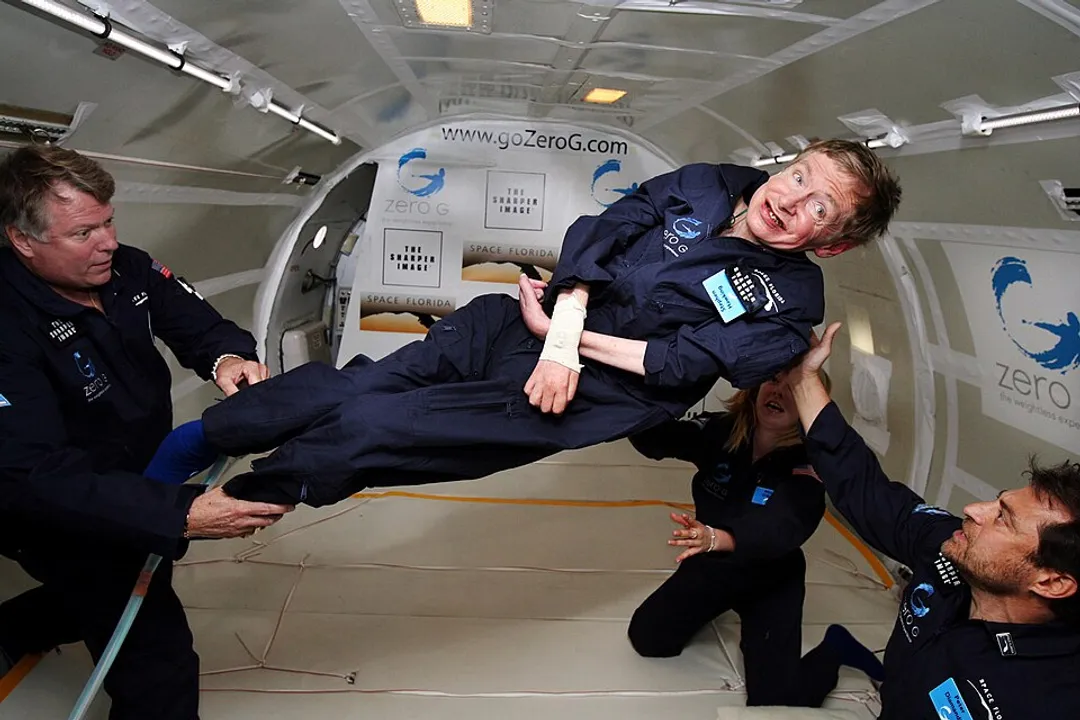
If the threat from advanced intelligence is real, and if the long-term viability of Earth remains questionable due to climate instability or other terrestrial risks, Hawking strongly advocated for a radical change in human behavior: we must become a multi-planetary species.
He emphasized that humanity cannot afford to keep all its eggs in one basket, stressing the need to colonize space to ensure our survival over the long haul. This idea is pragmatic, serving as a potential hedge against both the self-inflicted wounds of environmental damage and the cosmic threats, such as asteroid impacts, that have periodically shaped Earth's history. For a man who spent his life contemplating deep time and vast distances, the move outward was the logical next step for a species aspiring to permanence.
This view contrasts slightly with the sheer scale of his cosmological predictions. While he explored the theoretical boundaries of the universe and its potential infinite nature, his advice for human action was grounded in near-term, achievable engineering goals—building the rockets and habitats necessary to escape Earth. This duality—a mind focused on the incomprehensibly large, yet offering pointed advice for our immediate, terrestrial situation—is characteristic of his later career.
# Final Essay
The breadth of Hawking’s final contemplation is best seen in Brief Answers to the Big Questions. Released after his death, this book acts as a distillation of his thinking across cosmology, philosophy, and life itself. It tackled subjects ranging from the existence of a creator to the nature of time travel and the search for extraterrestrial life.
In this work, he summarized his belief that the universe operates according to physical laws that can be understood, diminishing the need to invoke supernatural explanations for its origins. He was cautious about extraterrestrial life, suggesting that if advanced civilizations existed, they might not be friendly, perhaps viewing less developed planets as resources to conquer, a warning echoing colonization themes in a cosmic context.
The structure of his final published work provides a helpful index for readers seeking his definitive answers on the big questions, consolidating theories that he had been developing and refining for decades. Though the universe he described was vast and governed by elegant mathematics, his closing message to humanity was surprisingly down-to-earth: secure your future on Earth by planning for the stars, and actively manage the powerful new technologies you create.
#Videos
What was Stephen Hawking's Final Theory? - YouTube
Related Questions
#Citations
Two weeks before his death, Stephen Hawking predicted 'the end of ...
Stephen Hawking predicted exact date of apocalypse just before he ...
Stephen Hawking's warnings: What he predicted for the future - BBC
Hawking's predictions for earth's disappearance - Facebook
Stephen Hawking: two weeks before his death he predicted 'the end ...
This Is How Stephen Hawking Predicted The End Of The World
Stephen Hawking - Wikipedia
Stephen Hawking had chilling warning for mankind before death - Tyla
What was Stephen Hawking's Final Theory? - YouTube