tectonics articles

What are the two primary motions generally referred to when discussing the motion of the Earth?
Approximately how long does one full rotation of the Earth on its axis take, defining our standard day?
What period defines the Earth's revolution around the Sun, establishing the length of our year?
When viewed from above the North Pole, in which direction does the Earth's rotation occur?
What is the approximate angle of the Earth's axial tilt relative to the perpendicular of its orbital plane?
What combination of factors is the driving force behind our changing seasons?
Which specialized scientific discipline is dedicated to precisely measuring and predicting the movements of celestial bodies like Earth?
What physical consequence of Earth's rotation dictates the large-scale movement of air masses and ocean currents?
How long is the sidereal day, which is the time it takes for Earth to rotate exactly 360 degrees relative to distant stars?
What observation provided the empirical proof that the Earth is moving in an annual circuit around the Sun?
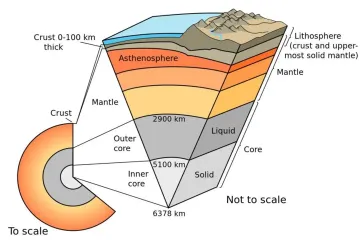
What is the fundamental mechanism responsible for driving the movement of tectonic plates?
Which two components comprise the Earth's rigid outer layer, the lithosphere?
What process occurs at divergent boundaries where plates move away from each other?
What geological feature is typically formed when an oceanic plate subducts beneath a less dense continental plate?
What example is provided for a continental collision zone where two continental plates meet?
What is the primary geologic consequence of plates sliding horizontally past one another at transform zones?
At what approximate speed are tectonic plates currently moving?
What layer beneath the lithosphere allows the rigid tectonic plates to glide across it?
What does the balance between seafloor spreading and crust destruction imply about Earth’s size?
What feature is formed at divergent boundaries, often described as vast underwater mountain chains?