engine articles

What three primary components are necessary for the fundamental combustion reaction in an ICE?

What three primary components are necessary for the fundamental combustion reaction in an ICE?

What percentage of Earth's surrounding air serves as the oxidizer for conventional engines?

What percentage of Earth's surrounding air serves as the oxidizer for conventional engines?

What happens immediately if an engine is run in an environment with zero ambient oxygen and no alternative oxidizer is supplied?

What happens immediately if an engine is run in an environment with zero ambient oxygen and no alternative oxidizer is supplied?

What is the primary engineering challenge when an ICE is supplied with pure oxygen instead of atmospheric air?

What is the primary engineering challenge when an ICE is supplied with pure oxygen instead of atmospheric air?

Which critical failure mode involves the incoming fuel/oxidizer mixture igniting before the spark plug fires due to excessive internal heat?

Which critical failure mode involves the incoming fuel/oxidizer mixture igniting before the spark plug fires due to excessive internal heat?

What is the term for the rapid, uncontrolled explosion within the cylinder that can severely damage pistons and connecting rods?

What is the term for the rapid, uncontrolled explosion within the cylinder that can severely damage pistons and connecting rods?

What component, present in atmospheric air, is removed when switching to pure oxygen, contributing to cooling inefficiency?

What component, present in atmospheric air, is removed when switching to pure oxygen, contributing to cooling inefficiency?

If an engine must operate in an environment without atmospheric air, like on Mars, what modification is mandatory for its oxidizer supply?

If an engine must operate in an environment without atmospheric air, like on Mars, what modification is mandatory for its oxidizer supply?

What type of construction materials are required for engine internals if they are intended to operate continuously under the sustained high temperatures caused by pure oxygen combustion?

What type of construction materials are required for engine internals if they are intended to operate continuously under the sustained high temperatures caused by pure oxygen combustion?

Why is a standard spark-ignition engine less suited to handle pure oxygen combustion compared to a liquid-fueled rocket engine?

Why is a standard spark-ignition engine less suited to handle pure oxygen combustion compared to a liquid-fueled rocket engine?

In an atmosphere like Venus's, which is primarily dense carbon dioxide, what is the consequence for standard hydrocarbon fuel combustion?
In an atmosphere like Venus's, which is primarily dense carbon dioxide, what is the consequence for standard hydrocarbon fuel combustion?

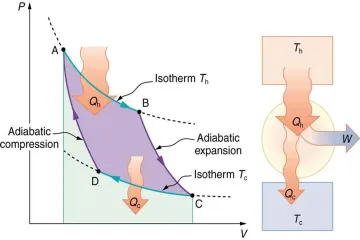
How is the thermal efficiency ($	ext{eta}$) of a heat engine calculated based on energy inputs and outputs?

How is the thermal efficiency ($ ext{eta}$) of a heat engine calculated based on energy inputs and outputs?

What fundamental requirement dictates that the efficiency of any real heat engine must always be less than 100%?

What fundamental requirement dictates that the efficiency of any real heat engine must always be less than 100%?

What factors exclusively determine the Carnot efficiency, according to the derived formula?

What factors exclusively determine the Carnot efficiency, according to the derived formula?

In what temperature scale must $T_H$ and $T_C$ be expressed to correctly calculate Carnot efficiency?

In what temperature scale must $T_H$ and $T_C$ be expressed to correctly calculate Carnot efficiency?

What is the fundamental thermodynamic requirement for extracting work from a heat engine?

What is the fundamental thermodynamic requirement for extracting work from a heat engine?

Which principle serves as the theoretical foundation proving that no heat engine can be more efficient than a reversible engine operating between the same two temperatures?

Which principle serves as the theoretical foundation proving that no heat engine can be more efficient than a reversible engine operating between the same two temperatures?

Which of the following represents an irreversible process causing real engines to fall short of the Carnot limit?

Which of the following represents an irreversible process causing real engines to fall short of the Carnot limit?

Besides thermodynamic limits, what practical constraint governs the achievable operating temperature ($T_H$) in modern engines?

Besides thermodynamic limits, what practical constraint governs the achievable operating temperature ($T_H$) in modern engines?

How does the Second Law of Thermodynamics differentiate itself from the First Law regarding energy?

How does the Second Law of Thermodynamics differentiate itself from the First Law regarding energy?

If Plant A has $T_H = 900 	ext{ K}$ and Plant B has $T_H = 1200 	ext{ K}$ (both rejecting at $T_C = 300 	ext{ K}$), what does this illustrate about efficiency gains?

If Plant A has $T_H = 900 ext{ K}$ and Plant B has $T_H = 1200 ext{ K}$ (both rejecting at $T_C = 300 ext{ K}$), what does this illustrate about efficiency gains?