crust articles

What are the two primary motions generally referred to when discussing the motion of the Earth?
Approximately how long does one full rotation of the Earth on its axis take, defining our standard day?
What period defines the Earth's revolution around the Sun, establishing the length of our year?
When viewed from above the North Pole, in which direction does the Earth's rotation occur?
What is the approximate angle of the Earth's axial tilt relative to the perpendicular of its orbital plane?
What combination of factors is the driving force behind our changing seasons?
Which specialized scientific discipline is dedicated to precisely measuring and predicting the movements of celestial bodies like Earth?
What physical consequence of Earth's rotation dictates the large-scale movement of air masses and ocean currents?
How long is the sidereal day, which is the time it takes for Earth to rotate exactly 360 degrees relative to distant stars?
What observation provided the empirical proof that the Earth is moving in an annual circuit around the Sun?
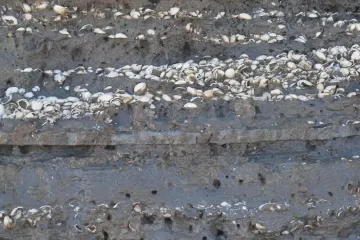
What concept describes the Earth's slow-motion process of geological recycling?
How many fundamental rock types do geologists recognize?
What dictates the final texture of an igneous rock?
What results from magma cooling very slowly deep beneath the surface?
What process produces fragments called sediment through physical and chemical breakdown?
What process follows erosion and involves sediments settling out in layers?
Metamorphic rocks are fundamentally altered by what combination of intense conditions?
What rock is formed when limestone is subjected to intense heat and pressure?
What large-scale movement fundamentally powers the entire rock cycle?
What process drives the massive recycling of rock into new igneous material deep below the surface?
Which type of crust is recycled much more slowly, often remaining near the surface for billions of years?
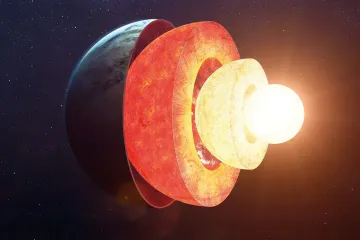
Which layer constitutes the majority of the Earth’s volume?
What is the primary indirect method used to study Earth's deep interior?
How does the mantle behave over geological timescales?
What are the massive, puzzling structures revealed in the lower mantle often interpreted as?
What celestial body's potential remnants are hypothesized to be preserved deep within the mantle?
What essential planetary function is generated by the churning motion of the liquid outer core?
What observation suggests that the inner core is not entirely uniform internally?
How do the deep biosphere lifeforms primarily derive their energy?
What is implied about planetary accretion if chemically distinct materials from an impactor persist in the mantle?