How does biodiversity enhance ecosystem resilience?
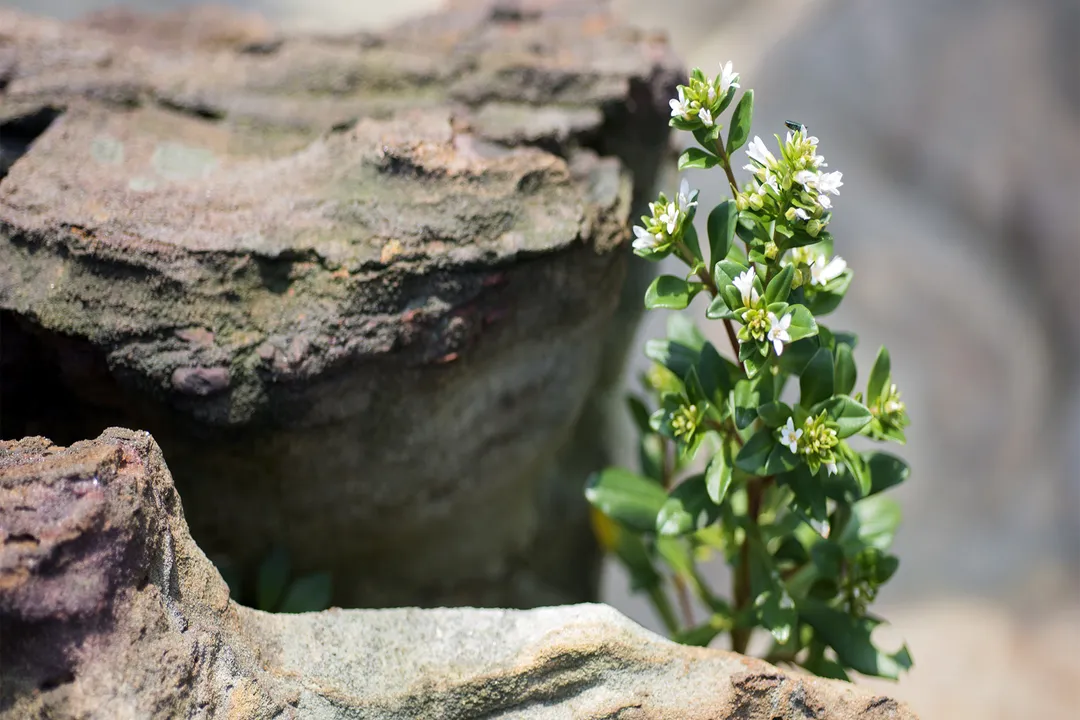
The capacity of an ecosystem to absorb a shock—be it a severe drought, an intense storm, or a novel pathogen outbreak—and continue to provide the same fundamental services is what ecologists call resilience. [2][8] This isn't just about bouncing back; it’s about maintaining identity and function even when stressed. [2] At the heart of this stability, acting as the essential scaffolding, is biodiversity. [9] When we talk about biodiversity, we mean the variety of life at all levels—genes, species, and ecosystems—and it’s this variety that equips natural systems to weather environmental turbulence far better than simplified, monoculture-like systems can. [4]
# Functional Backup
One of the primary ways species variety bolsters an ecosystem is through something known as functional redundancy. [3] Think of an ecosystem as a complex machine with many moving parts. If one part breaks, the machine can stop working. However, if that machine has several identical backup parts ready to step in, the failure of one component doesn't halt the entire operation. [3] In nature, functional redundancy means that multiple species might perform the same vital role, such as fixing nitrogen, decomposing organic matter, or pollinating flowers. [3]
If a sudden frost wipes out the most common pollinator in a region, an ecosystem rich in species diversity might still have several less common, but equally capable, pollinators that can take over the slack, ensuring that plant reproduction continues, albeit perhaps at a slightly reduced rate. [1] This compensatory mechanism is critical because environmental pressures are rarely uniform; a change that harms one group of species may actually benefit another, keeping the overall process running. [1] Where functional redundancy is low—meaning only one or two species handle a key function—the system is inherently brittle and highly susceptible to collapse when those few species are impacted. [4]
# Resistance Recovery
Ecosystem stability is often viewed through two lenses: resistance and resilience, or recovery. [1] Resistance describes how much an ecosystem avoids changing in the first place when a disturbance occurs. Resilience, on the other hand, describes how quickly the system returns to its pre-disturbance state or function after the stress has passed. [1] Biodiversity appears to positively influence both aspects, though in sometimes different ways depending on the disturbance type.
For instance, high species richness can increase resistance because a wider array of species means the community as a whole is less likely to be completely wiped out by a targeted event. [4] Conversely, recovery might be enhanced because a greater pool of species means there are more candidates available to recolonize damaged areas or resume halted processes once conditions allow. [1] A forest with many native tree species, for example, will likely show better resistance to a specific bark beetle infestation than a pure stand of one susceptible species, and post-fire, the regeneration from various seed banks and surviving root systems will be quicker and more complete. [6]
# Stress Buffering

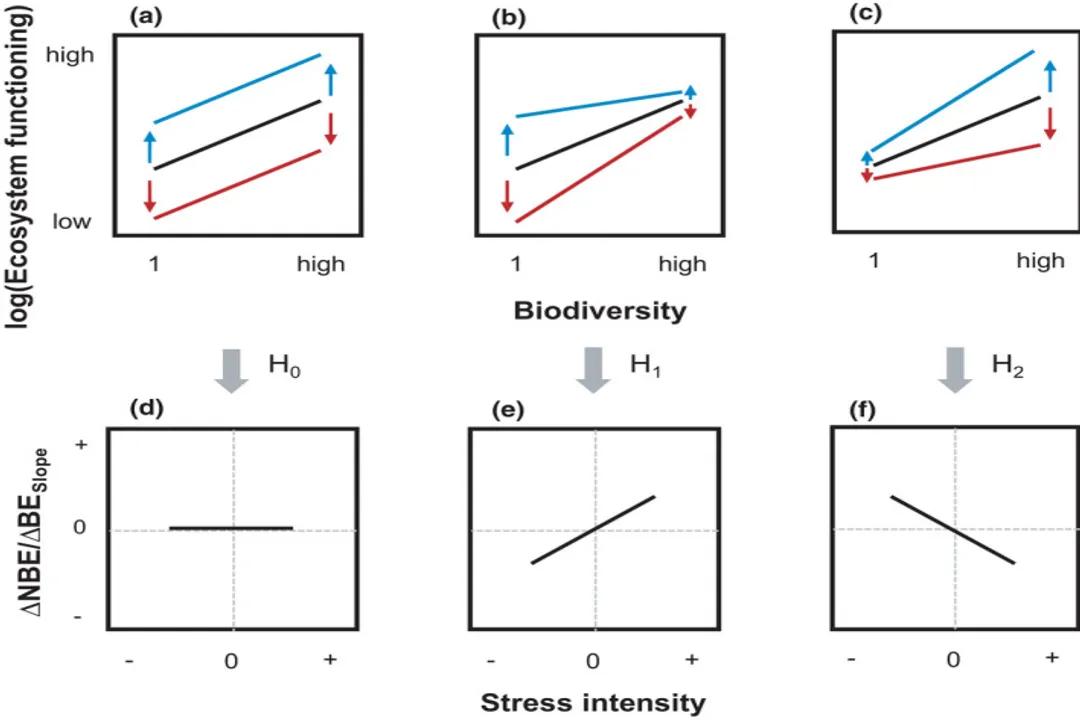
Ecosystems face constant, often compounding, stressors. Climate change introduces novel temperature extremes and altered precipitation patterns, while human activity often introduces pollution or invasive species. [2][8] Biodiversity acts as a critical buffer against these pressures.
When conditions shift—say, temperatures climb higher than historic averages—different plant species have different physiological tolerances. [1] In a diverse grassland, some species may thrive in the new heat, while others may decline, yet the net primary productivity of the entire area might remain relatively constant because the winners compensate for the losers. [1] This is a direct contrast to a simplified agricultural field where a single crop, specialized for a narrow range of conditions, might fail entirely under the same stress. [8]
This buffering effect extends powerfully to biological threats like pests and diseases. [6] A classic example involves forest health. If a pathogen emerges that targets one specific tree species, a forest dominated by that species faces regional devastation. [6] However, in a mixed-age, mixed-species forest, the pathogen cannot easily spread because its required host is interspersed with non-hosts, effectively creating a natural barrier that slows or stops epidemic spread. [6] This structural difference is one of the most tangible ways diversity translates directly into system integrity, especially in managed landscapes like forests where pest outbreaks can be magnified. [6]
# Portfolio Effect

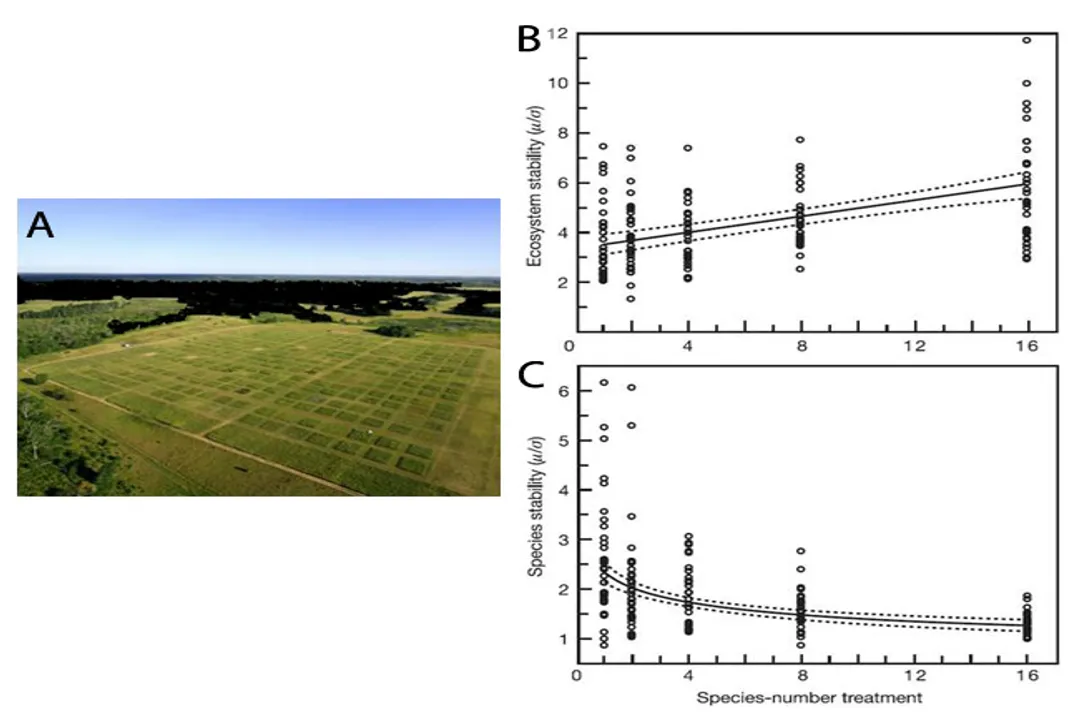
A concept closely related to functional redundancy is the species portfolio effect. [1] This idea borrows from finance, suggesting that a diverse portfolio of investments is less volatile than a concentrated one. In ecology, if species respond differently to environmental variability—meaning their population fluctuations are not perfectly synchronized—the overall average population size for that functional group will be more stable over time. [1]
Imagine two species of grass crucial for soil stabilization. Species A does well during wet years but poorly during dry years. Species B performs the opposite: poorly when wet but robustly when dry. [4] If the ecosystem only had Species A, its soil stabilization function would fluctuate wildly year to year. But with both present, the wet year's success from A balances the dry year's success from B, leading to a much steadier rate of soil stabilization across the span of years. [1][4] This dampening of temporal variation—the smoothing out of the bumps over time—is a direct result of having varied biological responses that don't all succeed or fail simultaneously. [1]
For those managing land, recognizing this means that the value of an area isn't just in the number of species, but in the difference between how those species react to predictable environmental cycles. A small pond that supports one type of frog active in early spring and another active in late summer provides a more continuous functional output than a pond that only supports one species active only in mid-spring. [5]
# Operational Linkages
Biodiversity is essential because it underpins the continuity of ecosystem processes, which are the services humans depend upon. [9] Healthy ecosystems are intricate webs where nutrients are cycled, water is filtered, and energy flows predictably from producers to consumers. [9] If the diversity is high, it suggests that the "wiring" connecting these processes is redundant and complex, making the entire network harder to sever. [9]
Consider water purification in a wetland. Different plant species have varying abilities to uptake specific pollutants, and different microbial communities process different types of organic waste. [9] A simple wetland dominated by one or two reed species might effectively filter nitrates, but it might fail completely to manage heavy metal contamination introduced by runoff. [9] A biodiverse wetland, drawing on a spectrum of plant and microbial genetics, offers a much broader and more reliable filtration capacity. [9] Maintaining this functional breadth is not just about keeping nature "pretty"; it's about guaranteeing the operational reliability of our life support systems. [7]
One way to visualize this operational dependency is to consider the sheer volume of unique interactions an ecosystem sustains. While the primary food web may only involve a few dozen species, the supporting microbial, fungal, and insect interactions number in the thousands, each contributing to decomposition, soil structure, and nutrient availability. [5] The loss of a seemingly minor insect species might not cause an immediate famine, but it could reduce the efficiency of a particular decomposition pathway by 10%, which, when compounded over decades across multiple pathways, leads to soil depletion and reduced plant vigor, ultimately eroding resilience against drought. [6]
# Local Landscape Heterogeneity
When we look at resilience on a landscape scale, the arrangement of diverse patches matters significantly. My own observation when analyzing regional biodiversity maps is that areas possessing high heterogeneity—meaning a varied mosaic of different habitat types right next to each other—tend to be the most stable regions over decades, even when facing localized extreme weather events. It’s not enough to have a species checklist of 50 birds across a county; you need patches where those birds can breed, feed, and shelter in different configurations. [4]
For example, a lowland area might have high species richness, making it resilient to flooding because it contains water-tolerant species. But if that lowland is bordered by diverse uplands—containing drought-tolerant shrubs and different fungi—the entire region can rapidly source the necessary organisms to recolonize the flooded area once the waters recede. [2] If the region was only composed of that single lowland type, the recovery would be slower, relying only on those few species that could survive brief inundation, or requiring external immigration. [1] This connectivity between distinct, yet functionally complementary, habitats creates a meta-system resilience that individual habitats cannot achieve alone. [8]
# Scaling Stability Factors
The relationship between diversity and stability isn't always linear; the type of diversity often matters more than the sheer count of species once a certain threshold is passed. [4] Some research suggests that once you have about 10 to 15 species performing a core function, adding the 16th, 17th, or 100th species might provide diminishing returns on resistance to a general disturbance like a heatwave. [1][4] However, adding species that respond uniquely to rare or unpredictable disturbances—like a novel invasive weed or an unusually long period of drought—can still dramatically improve overall long-term resilience. [1]
This leads to an interesting analytical point: we should measure resilience not just by the stability of the average year, but by the stability of the worst possible scenario we can reasonably project. Ecosystems with high species diversity tend to perform better under those worst-case projections because they maintain a broader range of biological options that might prove essential under extreme, atypical conditions. [3] It’s like having a diverse tool kit; you might only need a hammer and screwdriver most days, but when the plumbing bursts, you need that specialized pipe wrench that only one species in the community possesses the genetic makeup to produce or repair.
# Supporting Ecosystem Health
Understanding these underlying mechanisms—redundancy, varied responses, and functional breadth—highlights why efforts to maintain and restore biodiversity are so critical to ensuring the long-term health of our natural surroundings. [9][7] Supporting this variety means protecting not just charismatic megafauna, but the understory plants, the soil microbes, and the fungi that underpin the entire structure. [5]
When individuals or communities take steps to support biodiversity, they are effectively investing in the system's insurance policy. [7] This could mean creating varied planting schemes in gardens, reducing pesticide use that indiscriminately removes non-target insects essential for decomposition, or advocating for landscape management that favors mixed stands of native plants over simplified plantings. [7] Every new species added that performs a function slightly differently from its neighbors increases the collective capacity of that system to absorb the unexpected punches nature inevitably throws. [2] In essence, biodiversity doesn't just make ecosystems better; it makes them tougher. [9]
Related Questions
#Citations
Biodiversity and Ecosystem Stability | Learn Science at ...
How Does Biodiversity Enhance Resilience? → Question
Biodiversity promotes ecosystem functioning despite ...
Biodiversity and Ecosystem Resilience | GEOG 30N
Why biodiversity is so important to the health of an ...
Biodiversity increases the resistance of ecosystem productivity ...
How You're Strengthening Ecosystems by Supporting ...
Environmental resilience: biodiversity and ecosystems
Biodiversity Critical to Maintaining Healthy Ecosystems