How does a superconductor cooled in a magnetic field differ from a hypothetical, perfectly conducting material upon cooling?
Answer
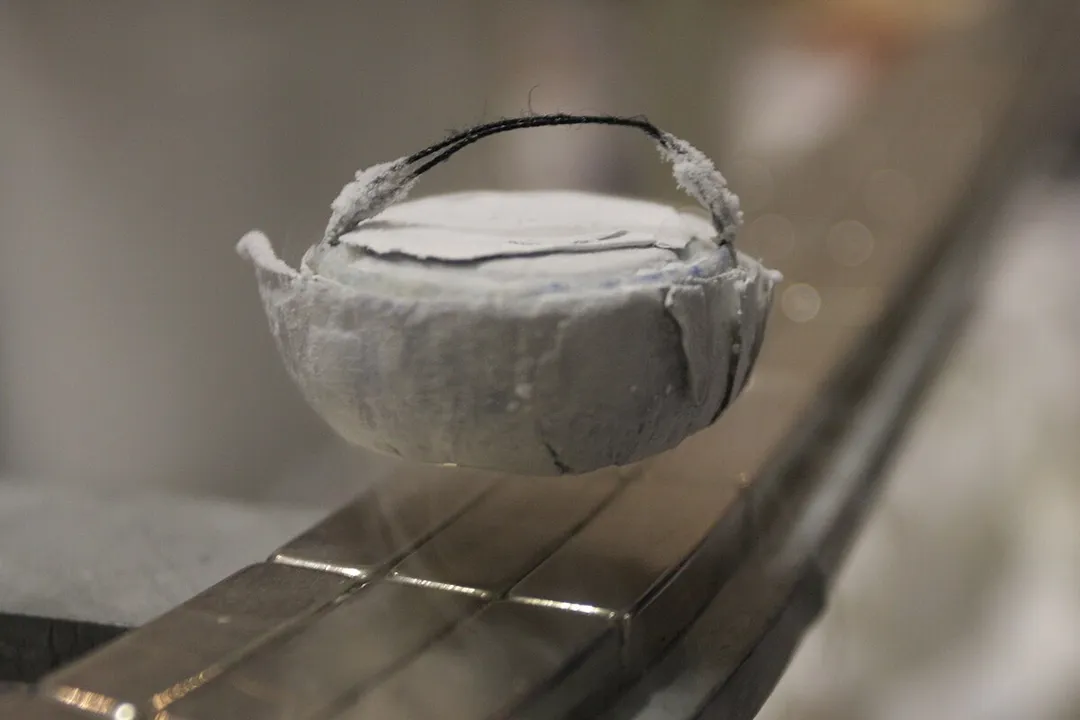
The superconductor actively expels internal magnetic field lines (Meissner effect).
A hypothetical perfect conductor would trap flux inside. A true superconductor actively expels all internal magnetic field lines when cooled below $T_c$, a defining characteristic known as the Meissner effect.
Related Questions
What are the two primary obstacles causing energy loss as heat in normal conductors?Who first observed the sudden vanishing of electrical resistance and at what approximate temperature?If a material in a superconducting state exceeds which three critical parameters, will it immediately revert to its normal, resistive state?What mediates the attractive force that allows electrons to form Cooper pairs despite their natural repulsion?How do Cooper pairs behave quantum mechanically compared to individual electrons below $T_c$?Why does the collective condensation of Cooper pairs below $T_c$ result in exactly zero resistance?How does a superconductor cooled in a magnetic field differ from a hypothetical, perfectly conducting material upon cooling?The complete exclusion of magnetic flux characteristic of a superconductor cooled below $T_c$ is known as what property?What happens to a Type I superconductor when the applied magnetic field strength exceeds its critical magnetic field ($H_c$)?What state do Type II superconductors enter when the magnetic field is between $H_{c1}$ and $H_{c2}$?