For Total Internal Reflection to be successfully induced, how must the angle of incidence at the core-cladding boundary relate to the critical angle?
Answer
The angle of incidence must be greater than the critical angle.
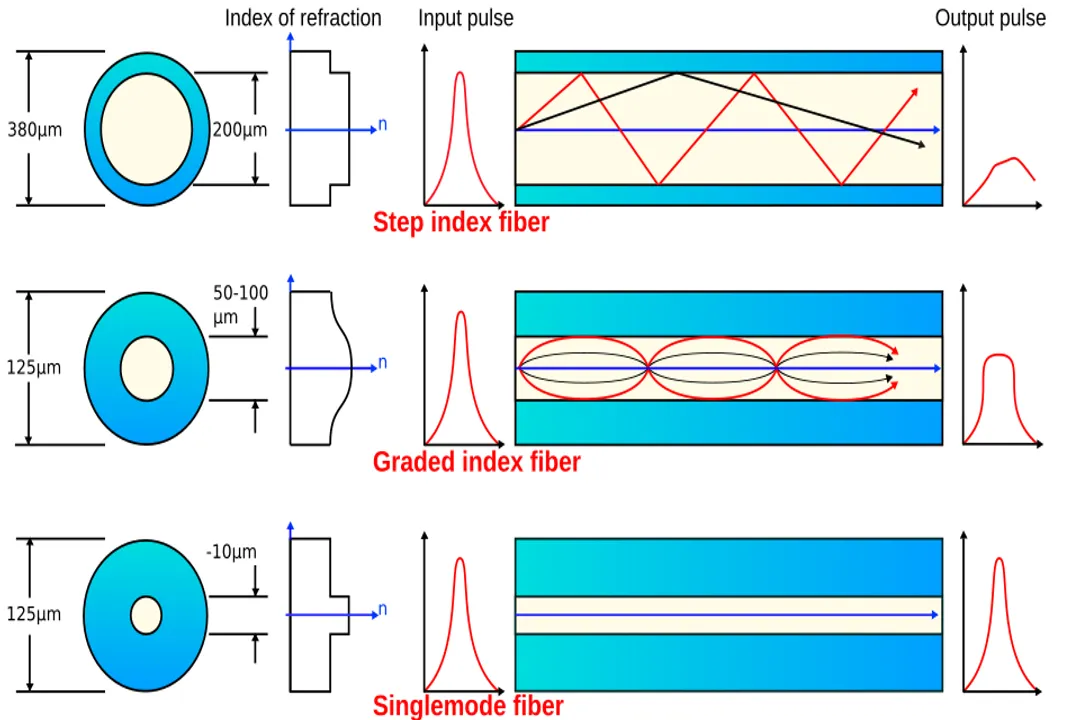
If the light ray strikes the boundary at an angle exceeding the critical angle, it is guaranteed to be reflected entirely back into the denser medium, preventing refraction out into the cladding.
#Videos
How Fiber Optics Works - YouTube
Related Questions
What must be true about the refractive indices of the core and cladding for Total Internal Reflection to function?What is the primary role of the protective buffer coating surrounding the optical fiber cladding?What physical phenomenon is the core principle enabling light to travel long distances within the fiber core?What physical property causes light to bend when it passes from air into water?What limits the distance and bandwidth capability of Multi-Mode Fiber (MMF) compared to Single-Mode Fiber (SMF)?In fiber optics, what does the term 'refractive index' quantify?For Total Internal Reflection to be successfully induced, how must the angle of incidence at the core-cladding boundary relate to the critical angle?What does the Numerical Aperture (NA) of an optical fiber mathematically describe?Why is highly purified silica glass the material of choice for long-haul telecommunication fiber?In single-mode fiber (SMF), what feature allows it to carry data at extremely high rates over very long distances?