What is considered a fireball?
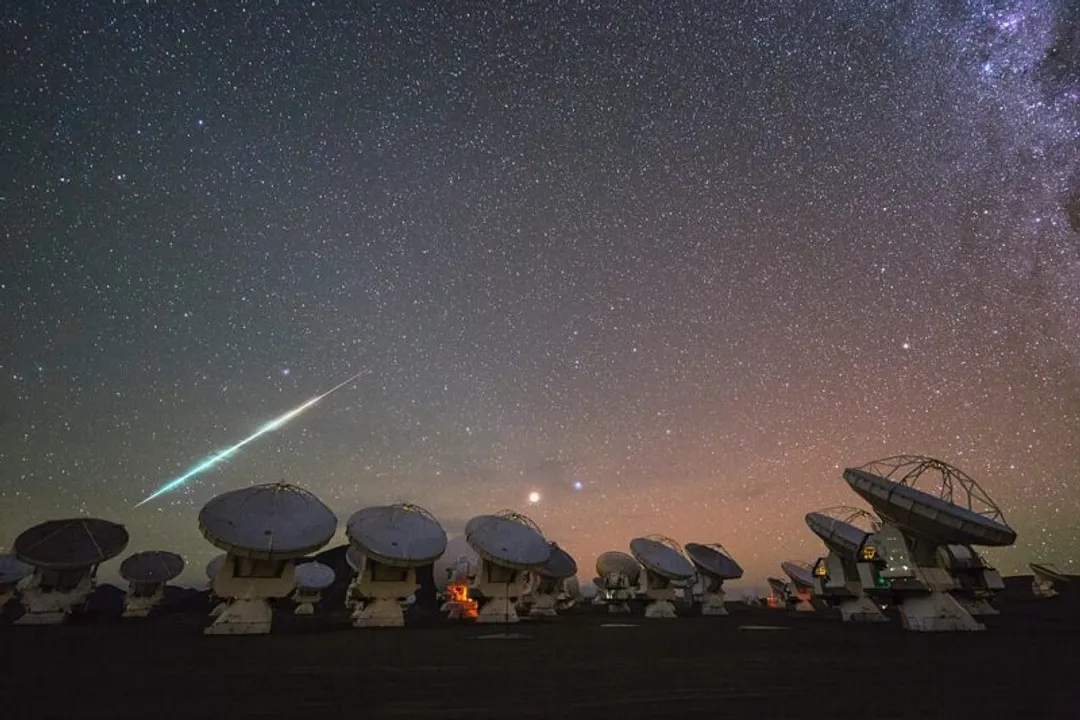
The streak of light that suddenly illuminates the night sky, often startling onlookers, is frequently labeled a "fireball," but what exactly qualifies an object to earn this dramatic title? At its most fundamental level, a fireball is simply a meteor that is exceptionally bright as it streaks through the Earth's atmosphere. [1][4] It is a celestial event observable by the naked eye, representing a piece of space debris—perhaps a meteoroid, asteroid, or comet fragment—encountering our planet at high velocity. [1][5] The key differentiator is not the object's composition or origin, but the sheer visual spectacle it produces during its brief, fiery descent. [1]
# Bright Meteors
To be classified as a fireball, a meteor must exceed a certain threshold of brightness when viewed from Earth. [4] While the term itself sounds evocative, in astronomical terms, it adheres to a specific measure related to apparent magnitude. [5] A meteor is generally defined as the visible streak of light produced when a small piece of extraterrestrial material enters the Earth's atmosphere and vaporizes due to intense friction and heating. [5] When this process results in an object shining brighter than the planet Venus, it earns the designation of a fireball. [1][5] Venus, being the third brightest natural object in the night sky after the Moon and the Sun, sets a relatively high bar for visual prominence. [1]
It is important to recognize that "fireball" is a descriptive term based on appearance rather than a formal classification of the object's parent body or size, though the brightness correlates with a larger or faster-moving meteoroid. [5] These events are relatively uncommon compared to typical, faint meteors, making any sighting a noteworthy occurrence for amateur and professional observers alike. [1][5]
# Names Defined
The vocabulary surrounding these bright space rocks can be confusing, as several terms are used interchangeably or have very specific scientific meanings that overlap with the general description of a fireball. Understanding the nuance between a meteor, a bolide, and a fireball helps clarify what is actually happening in the sky. [6]
A meteor is the streak of light we see. [5] If the object causing the light is still intact as it burns up, it's a meteor. [6] If a piece of that debris survives the atmospheric plunge and lands on the ground, it becomes a meteorite. [5]
The term bolide is often used in conjunction with or instead of fireball, particularly when the object is very large or explodes in the atmosphere. [6] Generally, a bolide is defined as a meteor that explodes in a bright flash or fireball. [6] Some sources define a bolide as a fireball brighter than the planet Jupiter, though the precise demarcation between a very bright fireball and a bolide can vary depending on the source or scientific context. [1][6] For many observers, if the object fragments dramatically or explodes with a loud noise, it is often immediately labeled a bolide. [6] Therefore, while all bolides are fireballs (due to their brightness), not all fireballs might be classified as bolides if they do not detonate or fragment violently. [1][6]
Consider this comparative distinction: if a piece of space rock enters the atmosphere and shines as brightly as Sirius (the brightest star in the night sky), it qualifies as a fireball. If it shines brighter than Venus, some standards might elevate it to a bolide classification, suggesting a more massive object or a more dramatic disintegration. [1] This scale helps place the visual event into context for observers tracking these phenomena.

# Magnitude Scale
The defining characteristic of a fireball is its apparent magnitude, a measure of brightness used in astronomy. [5] Magnitude scales work inversely to common sense regarding numbers: the smaller the number, the brighter the object. [1]
For context, the Sun has a magnitude of approximately $-26.7$, and a full moon is around $-12.7$. [1] Venus, the benchmark for a fireball, shines at about $-4.5$. [1] Any meteor brighter than this threshold—meaning a magnitude less than $-4.5$—is officially recognized as a fireball. [1][5]
The scientific community often uses even lower (brighter) numbers for the most spectacular events. For instance, objects reaching magnitudes of $-6$ or lower are extraordinarily rare and exceptionally bright. [1]
To put this extreme brightness into a framework that is immediately relatable: imagine a meteor blazing across the sky with a magnitude of $-10$. That object would be significantly brighter than any planet or star routinely visible, easily outshining even a quarter moon. [1] If you happen to be indoors and see the shadow of a nearby object seemingly flicker or disappear momentarily due to the flash of light from a very bright fireball, you are likely witnessing an object in the $-10$ or lower range. [1] This level of illumination is unusual and signifies a significant physical presence interacting with the atmosphere. [5]
# Atmospheric Entry
When a meteoroid enters the upper atmosphere, it is traveling at incredible speeds, often tens of kilometers per second. [5] The air in front of the object compresses and heats up intensely, causing the outer layers of the meteoroid to vaporize. [5] This incandescent gas forms the visible streak we call the meteor, or in this bright case, the fireball. [5]
The path of a fireball can often be tracked across the sky, providing valuable data for scientists attempting to trace its origin. [1] Observers might note the color of the streak, which can sometimes offer clues about the material composition of the incoming object, as different elements burn with distinct colors—for example, sodium can produce a yellow-orange light, while magnesium might yield a greenish tint. [5]
Another fascinating aspect of very bright fireballs is the potential for an associated sonic event. [5] As the object travels through the air faster than sound, it creates a powerful shockwave, which we perceive on the ground as a sonic boom. [5] Unlike the continuous, bright light, this sound arrives after the visual event, as light travels much faster than sound. [1] If the fireball is particularly massive and breaks up high in the atmosphere, this boom can be quite loud, sometimes being mistaken for an explosion or even distant thunder. [5]
It's helpful for anyone witnessing such an event to make mental notes immediately afterward. If you are recording the sighting, noting the precise time, the direction the fireball was traveling, and its apparent duration—even a rough estimate like "it lasted about three seconds"—can provide enough data for researchers to pinpoint its trajectory using multiple observer reports. [1] This type of data corroboration is how scientists determine where the object originated and whether any fragments might have reached the ground. [1]
# Reality Versus Fiction
The term "fireball" carries significant weight in popular culture, often conjuring images from fantasy media where it implies a massive, instantaneous explosion capable of widespread devastation. [7][8] This is a crucial point of distinction: the astronomical fireball is a natural atmospheric phenomenon caused by superheated space debris, not a directed explosion of magical or high-yield conventional energy. [7]
In reality, the vast majority of fireballs burn up entirely in the upper atmosphere, far too high to cause any damage on the surface. [5] While the energy released during the visual phenomenon is immense—equivalent to many tons of TNT when considering the kinetic energy dissipated—it is spread over a very large volume of atmosphere and a short time frame, preventing catastrophic ground impact. [5]
The sheer energy release, however, is impressive. When a major fireball occurs, the energy converted into light and heat is significant, but the object itself is typically small—often no larger than a boulder before atmospheric entry. [5] The danger only becomes a genuine, albeit rare, concern when the object is large enough that it does not completely vaporize and survives the passage to become a meteorite that strikes the ground. [5] Even in these cases, the impact risk is minuscule compared to the probability of seeing the bright streak itself. [5] For the everyday person observing a streak, the only immediate impact is the breathtaking view. [1]
# Observation Insights
While tracking the velocity and trajectory is vital for scientific analysis, the experience of observing a fireball often centers on its visual characteristics. One interesting observation note is the relationship between brightness and apparent size. Because the light is created by superheating the air around the vaporizing object—not just the object itself—a very bright fireball can sometimes appear much larger than the actual meteoroid causing it, often described as having a glowing "head" or coma. [5] This visual effect can significantly exaggerate the perceived size of the incoming debris.
Furthermore, if you are ever involved in a large, organized effort to report a very bright fireball event, be aware of how local geography affects perception. If you are in a densely populated valley or near a large body of water, echoes of the sonic boom can sometimes create confusion about the number or location of fragmentation events. [5] It is always best to rely on immediate, direct observation rather than waiting for an assumed echo before recording the time of the visual flash. This temporal separation between the light and sound is one of the most reliable ways to confirm you have observed a genuine, high-speed atmospheric entry event.
In essence, a fireball is a stunning intersection of space and Earth, defined scientifically by its brightness relative to Venus, categorized in relation to the rarer bolide, and experienced by humanity as a fleeting, brilliant spectacle against the dark canvas of the night. [1][5][6]
Related Questions
#Citations
Fireballs and bolides - Nasa CNEOS
FIREBALL Definition & Meaning - Merriam-Webster
FIREBALL Definition & Meaning - Dictionary.com
What Is a Fireball? A fireball is an unusually large and bright meteor ...
Fireball | Research Starters - EBSCO
How Is a Fireball (Or Bolide) Different From a Meteor? - CosmoBC
Is a “fireball” an actual, possible thing, what damage would ... - Quora
Fireball - Definition, Meaning & Synonyms - Vocabulary.com
How dangerous would a Fireball actually be? : r/rpg - Reddit