What controls mineral hardness?
The resistance a mineral offers to being scratched, scratched, or permanently deformed is what we define as its hardness, a fundamental physical property that speaks volumes about its internal atomic architecture. This resistance isn't governed by a single characteristic but by a complex interplay of the forces holding its constituent atoms or ions together, combined with how those atoms are spatially organized within the crystal lattice. Understanding what controls this property gives us a window into the energy binding the very substance of the Earth.
# Bond Strength

The most significant factor determining a mineral's hardness is the type and strength of the chemical bonds linking its atoms or ions. A harder mineral generally possesses stronger internal bonds that require more energy to break or disrupt by introducing a foreign, harder material (the testing agent).
# Covalent Dominance
When atoms share electrons to form strong, directional covalent bonds, the resulting mineral structure is exceptionally tough and resistant to scratching. Covalent bonds are short, highly energetic bonds that create a very rigid, tightly knit structure.
Consider the extreme end of hardness: Diamond, which rates a perfect 10 on the established scale. Its unparalleled hardness stems almost entirely from its structure where every carbon atom is linked to four neighbors by perfect, incredibly strong covalent bonds, forming a rigid three-dimensional network. This structure offers immense resistance to deformation.
# Ionic vs. Metallic
In contrast, minerals held together predominantly by ionic bonds, where electrons are simply transferred rather than shared, tend to be softer. In an ionic structure, the forces are strong but less directionally specific than covalent bonds. When a sharp object is dragged across an ionic crystal, it can shift atomic planes slightly. If the movement places ions of the same charge next to each other, electrostatic repulsion occurs, causing the crystal to cleave or break relatively easily. Gypsum (hardness 2) and Calcite (hardness 3) are classic examples of minerals dominated by weaker bonding arrangements compared to the more robust structures above them on the scale.
Metallic bonds, found in native elements like gold or copper, are characterized by a "sea" of delocalized electrons. This arrangement allows the atomic planes to slide past one another relatively easily when stressed, leading to high malleability and relatively low hardness. This explains why even noble metals like Gold score low on the hardness scale—they are soft enough to be bent and shaped, which is the opposite behavior of a hard, brittle mineral.
# Scale Development
To quantify this physical property in a standardized way, geologists rely on a comparative system rather than absolute physical measurements, which can be difficult to reproduce consistently in the field.
# Friedrich Mohs
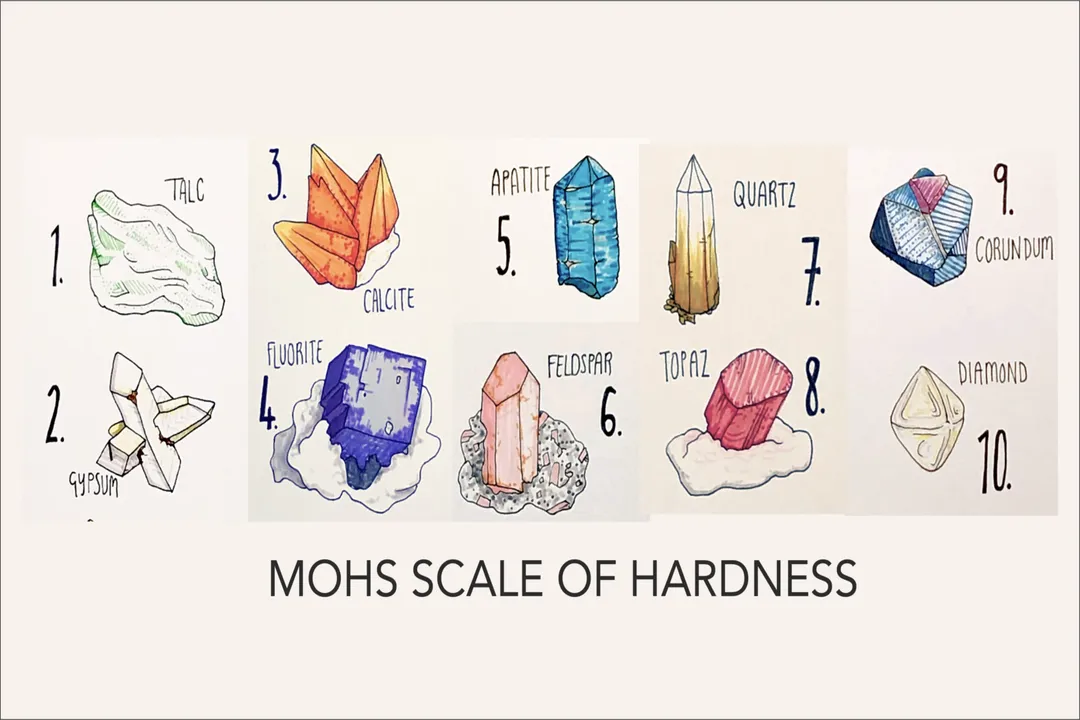
The system in common use today was developed in 1812 by German mineralogist Friedrich Mohs. Mohs devised a relative scale ranging from 1 to 10, using ten specific, readily available minerals as reference points. The principle is simple: any mineral on the scale can scratch any mineral lower than it and will be scratched by any mineral higher than it.
The historical selection of these ten reference minerals was pragmatic, intended to create a tool useful for fieldwork and identification, not necessarily a scientifically precise measurement of bond energy. The scale is ordinal, meaning it only indicates relative order, not the precise magnitude of the difference in hardness between steps.
# Reference Minerals
The ten minerals comprising the Mohs scale are fixed reference points, ensuring reproducibility across different tests performed by different people:
| Hardness | Mineral Reference | Common Test Agent Equivalent |
|---|---|---|
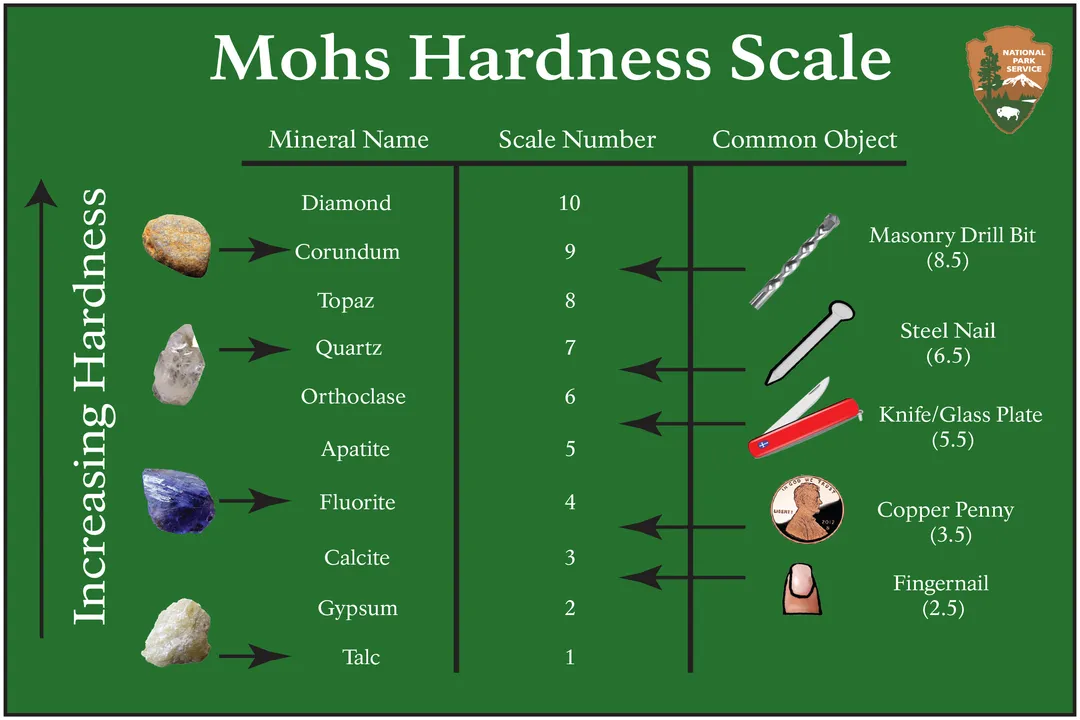
| 1 | Talc | Fingernail (approx. 2.5) |
| 2 | Gypsum | Fingernail |
| 3 | Calcite | Copper Penny (approx. 3.0–3.5) |
| 4 | Fluorite | Steel Nail (approx. 5.5) |
| 5 | Apatite | Steel Nail |
| 6 | Orthoclase Feldspar | Glass Plate (approx. 5.5) |
| 7 | Quartz | Steel Nail or Glass Plate |
| 8 | Topaz | Corundum (approx. 9) |
| 9 | Corundum | Topaz |
| 10 | Diamond | Diamond itself |
A fascinating practical implication arises when comparing the steps. While the scale appears linear, the actual physical difference in the required force to scratch increases dramatically as you move up. For instance, the jump in actual hardness from Corundum (9) to Diamond (10) is far more significant—in terms of bond energy required to break those covalent networks—than the difference between Talc (1) and Gypsum (2). This non-linearity is a direct consequence of the transition from structures dominated by weaker bonds to those entirely dominated by interlocking, three-dimensional covalent frameworks.

# Structure and Arrangement
While the type of bond is paramount, the way those bonds are configured in space—the crystal structure—modifies the final observed hardness. Minerals with identical chemical formulas can exhibit different hardness values if their internal arrangement differs, a phenomenon known as polymorphism.
# Packing Efficiency
The way atoms or ions are packed together within the crystal lattice influences how easily a surface plane can be fractured or displaced. A more densely packed structure, where the atoms are closer together and more efficiently arranged relative to the bonding forces, typically results in greater resistance to scratching. If the structure has many planes of weak bonding or large voids, it will be softer because the planes can slip past one another under a focused pressure point.
For example, the difference between the two polymorphs of carbon, graphite and diamond, illustrates structural control perfectly. Both are pure carbon with covalent bonds. However, Graphite is extremely soft (hardness 1–2) because its strong covalent bonds exist only in two-dimensional sheets, which are stacked loosely and held together by very weak van der Waals forces. These sheets slide effortlessly against each other. Conversely, Diamond has the same carbon atoms bonded covalently in a continuous three-dimensional matrix, making it the hardest known natural substance.
# Anisotropy in Hardness
Another structural consideration is anisotropy, meaning the properties vary depending on the direction in which the test is applied. In many crystals, the bonds are not equally strong in all directions. If a mineral has distinct structural planes—perhaps layers held by weaker forces nestled between layers held by strong forces—it will scratch much more easily when the stress is applied parallel to the weak plane. This directional variation is why some minerals exhibit distinct cleavage planes alongside varying hardness depending on the angle of the scratch.
When conducting field tests, this directional property means that an inconsistent scratch result might not indicate an impure sample but rather that the testing edge was applied across a structural weakness within the mineral itself. A good field geologist attempts to scratch perpendicular to any visible cleavage or twinning to get the most representative reading for that mineral's maximal hardness.
# Testing and Application
In practice, hardness testing is a practical skill that relies on understanding the limitations of the tools available.
# Field Procedures
The traditional field test uses the Mohs scale references directly, often simplified by substituting common items for the actual minerals. A geologist might use a fingernail (2.5), a copper penny (around 3.2), a piece of glass (about 5.5), or a steel knife blade or nail (about 5.5) to quickly approximate a mineral's position on the scale. If a mineral scratches glass but is itself scratched by quartz, you can confidently place its hardness between 5.5 and 7.
However, one must always be cautious about the testing agent itself. An old, soft steel nail will have a lower effective hardness than a freshly sharpened, high-quality steel file. It is wise for those doing regular fieldwork to keep a small "hardness kit" where the testing tools themselves are calibrated periodically. For instance, if your steel nail appears to scratch a specimen that you know from a previous test should be harder than steel, check the tip of the nail. A worn or rounded tip distributes the force over a wider area, potentially failing to create a proper scratch groove even if the steel is technically harder than the mineral.
When attempting to scratch a very hard mineral, like Topaz (8), it is crucial to apply firm pressure and ensure the testing point is sharp. Conversely, when testing a very soft mineral like Talc (1), even the slightest pressure from a fingernail will suffice, and you must inspect the result under magnification to distinguish a true scratch from a streak of the testing material left behind.
# Beyond the Scale
While the Mohs scale is excellent for identification, it struggles to describe the texture of the resulting scratch or fracture. For instance, a mineral with hardness 6 might shatter cleanly when scratched, while another with hardness 6 might only yield a narrow groove with visible signs of material extrusion at the sides. This difference relates to the mineral's tenacity (its resistance to breaking or crushing), which is independent of hardness. Tenacity involves factors like brittleness, cleavage, and toughness, which are separate mechanical properties from the resistance to scratching itself.
For those working in material science or high-precision geology, absolute hardness measurements, often using techniques like Vickers or Knoop indentation testing, provide precise data on the pressure required to cause a specific depth of penetration. These absolute methods reveal the true energetic differences that the ordinal Mohs scale merely implies.
To put this into a comparative context for everyday material selection, imagine trying to choose a durable countertop surface. Quartz (7) is a common choice because it resists scratching from everyday items like keys or loose grit. However, if you regularly deal with industrial abrasives or fine siliceous dust (which is essentially tiny quartz fragments), you are essentially testing a 7 against a 7, leading to wear over time. Surfaces like Corundum (9) are reserved for applications demanding extreme abrasion resistance, such as specialized bearings or cutting tools, precisely because the energy needed to cleave its tightly packed structure is orders of magnitude higher than what is required for Feldspar or Quartz.
In summary, the hardness of a mineral is primarily dictated by the strength of its chemical bonds—covalent bonds conferring the greatest resistance—and secondarily modulated by the efficiency and regularity of its crystal packing. This combination dictates how much localized energy is needed to permanently displace atoms on its surface, an easily observable phenomenon codified effectively by the simple, relative Mohs scale.
Related Questions
#Citations
Mineral - Hardness, Mohs Scale, Crystalline | Britannica
Mohs Hardness Scale (U.S. National Park Service)
What determines a mineral's hardness? | Wyzant Ask An Expert
Mohs scale - Wikipedia
Hardness of a mineral - The Learning Zone
What factors affect the hardness of different minerals? - Facebook
What most strongly influences a mineral's hardness? - Quora
3.6 Hardness - Minerals and the crystalline state - The Open University
Friedrich Mohs and the mineral scale of hardness - EGU Blogs