Why is reproducibility essential in experiments?
The ability for an experiment or analysis to be repeated and yield the same results is not merely a best practice in science; it is the bedrock upon which all scientific knowledge is built. When an initial finding cannot be verified by independent parties following the same procedures, its status shifts from established fact to mere observation or anecdote. [4] This demand for repeatability is fundamental to the scientific method itself, acting as the ultimate quality control mechanism that weeds out error, validates genuine discovery, and allows researchers to confidently move forward to the next stage of inquiry. [1][3] Without this check, the entire edifice of scientific understanding becomes unstable, risking the propagation of flawed conclusions across literature and practice. [7]
# Defining Terms
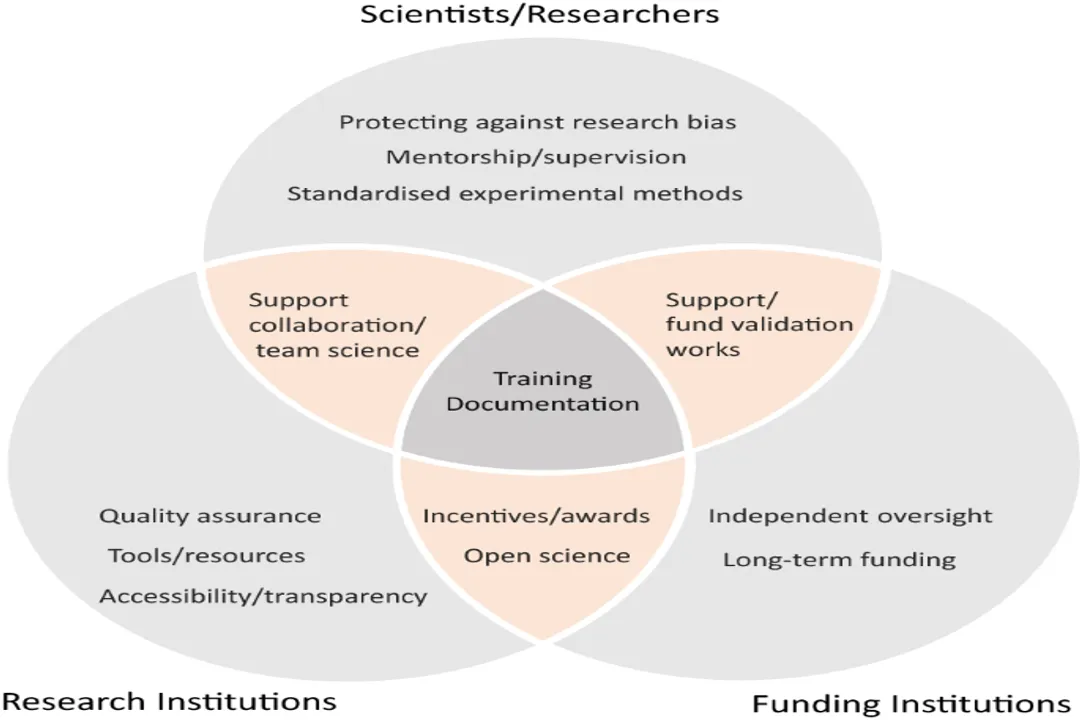
The discussion surrounding verification in research often blurs the lines between several related concepts, making precise language important. [7] It is helpful to clearly delineate what we mean by reproducibility versus replicability, as well as introduce the concept of robustness. [7]
Reproducibility, in its most direct sense, refers to the ability of a researcher to use the original researcher's data, code, and methods to arrive at the exact same results. [2] If the computation or analysis is performed again using the initial inputs, the output should match precisely. [2] This is often the first line of defense against accidental error or miscalculation in the initial work. [1]
Replicability takes this a step further. It requires that a new experiment, conducted by a different research group, using new samples or data gathered independently, but following the same stated experimental design and protocols, produces results that are statistically consistent with the original findings. [2][7] Where reproducibility checks the math and the code, replicability checks the phenomenon itself under independent conditions. [3] A finding that is reproducible but not replicable suggests the original result might have been a statistical fluke or dependent on an unstated variable in the original lab setup. [1]
A third term, robustness, describes whether the results hold true even when minor, non-essential variations are introduced into the experimental design or analysis pipeline. [7] While reproducibility and replicability address if the result is sound, robustness addresses how widely applicable the finding is. [7]
# Scientific Trust

The primary currency of science is trust, and reproducibility is the engine that generates it. [3] When researchers publish findings, they are asking the broader community—and often the public, funding agencies, or regulatory bodies—to accept those claims as truth or reliable knowledge. [1] This acceptance is not granted lightly; it is earned through demonstrable transparency and verification. [3]
If a scientific claim cannot be validated by others, it loses its authority, becoming little more than a personal observation. [4] This lack of independent verification stunts the growth of a field because subsequent research often builds directly upon prior findings. [8] If the foundation is faulty, every layer built on top of it is suspect. This erosion of trust is particularly damaging when research has real-world consequences, such as informing medical treatments or environmental policy. [3] The failure of an experiment to be reproduced can reveal subtle flaws in methodology, unexpected biases, or errors in the original interpretation, all of which strengthen science once corrected. [1]
If, for instance, a drug trial shows promising efficacy but the published protocol is too vague or the data sets are inaccessible, other labs cannot perform the critical confirmatory studies needed before moving to larger, more expensive clinical phases. This bottleneck slows down the entire research and development pipeline. [8] The cost isn't just the initial grant money wasted on a non-repeatable finding; it is the opportunity cost of the years that could have been spent advancing validated science instead of retreading old, inconclusive ground. [1] A single unverified publication can send dozens of independent research teams down unproductive paths, effectively wasting collective grant resources on re-proving something that was never proven in the first place. [3]
# Practical Laboratory Imperatives
In the context of physical laboratory work, especially in fields like biology or chemistry, reproducibility is a matter of process control. [9] Research laboratories function much like small manufacturing facilities, where output quality must be consistent. [9] When an experiment yields a positive result, researchers must be able to follow the documented steps to generate that result again consistently, whether it is to confirm a hypothesis or to produce a standard for quality control. [1][9]
One significant challenge arises from the complexity of biological systems, which inherently possess more variables than physical systems. The ability to move findings from the "bench" to clinical application depends heavily on this rigorous control. [9] If a protocol relies on a particular lot number of a reagent, or a very specific temperature fluctuation during incubation that was not explicitly recorded, the experiment becomes non-reproducible. [6] This is why developing standardized methods and using laboratory tools that automate and record environmental parameters—like those offered by diagnostic support systems—can be invaluable in locking down the necessary context for future success. [9]
For researchers striving for high standards, a practical tip involves building a protocol validation log that goes beyond the standard Methods section. This log should track not just the chemical suppliers, but the lot numbers of all critical consumables, the exact firmware version of any digital equipment used (e.g., a mass spectrometer or incubator controller), and the date the reagents were prepared or thawed. Treating these seemingly minor details as variables subject to testing ensures that when an experiment does work, the environment that produced that success is fully mapped out. [6]
# Computational Replication
The importance of repeatability has only amplified with the rise of computational science, where the data itself becomes the core experimental material. [5] In data science, machine learning, and bioinformatics, reproducibility shifts its focus from wet-lab protocols to the computational environment. [5]
Here, an analysis is reproducible if another data scientist can take the original data set and the original source code (including scripts, notebooks, and configuration files) and generate the identical statistical output or model prediction. [5] The main culprits in this domain are often dependency drift and environment mismatches. [5] A model trained using Python version $3.8$ and a specific version of the TensorFlow library might behave entirely differently or even fail to run when ported to Python $3.10$ with an updated library version, even if the core logic appears unchanged. [5]
To combat this computational reproducibility crisis, strict version control is necessary not just for the code, but for the environment itself. [5] A crucial element here is containerization technologies, such as Docker or specialized Conda environments. By defining the entire execution environment—operating system dependencies, library versions, and specific runtime configurations—within a single, shareable file, a researcher can ensure that the analysis runs identically today, a year from now, or on a completely different machine anywhere in the world. [5] This level of environment locking transforms an ephemeral computation into a documented, verifiable artifact.

# Barriers to Verification
Despite its recognized necessity, achieving reproducibility remains a significant challenge across many scientific domains, leading to what is sometimes termed the "reproducibility crisis," particularly noted in the life sciences. [6] Several systemic issues contribute to this difficulty.
One major barrier is insufficient methodological detail in published papers. [6] To truly recreate an experiment, every step must be described in enough detail that a competent researcher outside the original team can follow it without guesswork. [1] Often, standard laboratory practices that the original authors considered "obvious" are omitted, yet these details—like the exact mixing speed or the duration of a wash step—can be the difference between success and failure. [6]
Another significant factor is the reliance on proprietary software, closed-source code, or inaccessible data. [6] If the code used for statistical analysis is not made available, or if the data set is too large or sensitive to share openly, verification becomes impossible. [8] Furthermore, the commercialization of analytical tools can lock methods into specific hardware or software versions that become obsolete or unavailable, effectively making the original result impossible to check years down the line. [6]
The pressure within the current academic system also plays a role. The emphasis on publishing novel, positive results, rather than incremental confirmation studies, disincentivizes researchers from dedicating time to the painstaking work of making their methods perfectly transparent or repeating the work of others. [3]
# Cultivating a Culture of Openness
Overcoming these barriers requires a deliberate shift toward open science practices. [8] This transformation emphasizes sharing resources and methodologies as a standard component of research output, not an optional add-on. [8]
This shift involves several concrete actions:
- Data Sharing: Whenever possible, raw and processed data should be made publicly available alongside the publication, often through established, secure repositories. [8]
- Code Availability: Scripts, analysis pipelines, and models should be deposited in publicly accessible version control systems (like GitHub) with clear documentation on how to set up the necessary computational environment. [5][8]
- Pre-registration: For certain types of studies, researchers can pre-register their hypotheses, methodology, and analysis plan before data collection begins. This proactive step reduces the incentive to perform "p-hacking" or post-hoc data dredging to find a publishable result, thus increasing the credibility of the eventual finding, whether positive or negative. [3]
Ultimately, reproducibility is essential because science is a collective, iterative process. Every confirmed result provides the necessary springboard for the next level of discovery, saving time, money, and intellectual effort for the entire scientific community. [1][8] By treating the methods and data used to generate a result with the same care as the result itself, researchers ensure that their contributions truly add verifiable knowledge to the shared human enterprise. [3]
Related Questions
#Citations
Why is Reproducibility so Important to Scientists: Guide for 2022
Summary - Reproducibility and Replicability in Science - NCBI - NIH
Reproducibility and research integrity: the role of scientists and ...
Is reproducibility necessary in order to announce an experiment is ...
Reproducible Data Science and why it matters | by Carl W. Handlin
Six factors affecting reproducibility in life science research and how ...
The Importance of Reproducibility in Scientific Research
Reproducibility as a competitive advantage in life science R&D
The Importance of Reproducibility in Research Labs and How OPSD ...