Where does the spiral come from?

The spiral shape is one of humanity’s oldest and most pervasive graphic motifs, appearing in contexts as varied as microscopic life, immense celestial bodies, and profound spiritual beliefs. It is a curve that immediately captures attention due to its inherent sense of movement, an outward or inward progression that feels simultaneously ordered and organic. To ask where the spiral comes from is to query its presence in mathematics, nature, and the human psyche, revealing a form that seems intrinsic to the universe's design.
# Defining Curve

Mathematically, the term "spiral" refers to a specific type of curve defined by a point moving around a center while continuously increasing or decreasing its distance from that center. While many curves fit this general description, one of the most frequently cited is the Archimedean spiral, which has a constant distance between successive windings. This type of spiral is mathematically described when the radius () is directly proportional to the angle (), often written as . This simple linear relationship between rotation and radial distance dictates a very specific, predictable expansion.
However, not all spirals found in the real world adhere to the Archimedean model. The logarithmic spiral, sometimes called the growth spiral, is different because the distance between successive turns increases exponentially. This distinction is critical when observing phenomena in biology and physics. If we chart the growth of something like a nautilus shell, the shape remains constant as it grows larger; it is self-similar. This property means that any segment of the logarithmic spiral looks like the whole, a characteristic that defines many natural growth patterns.
When considering the mathematical foundation, one might observe that the universe seems to prefer the logarithmic spiral for organic development over the linear expansion of the Archimedean type. This preference suggests that for systems requiring continuous scaling while maintaining form—like a plant unfurling or a shell growing—the exponential relationship inherent in the logarithmic form is structurally superior or more likely to emerge from dynamic physical processes. The very definition of the spiral forces us to confront how simple algebraic rules can generate such complex, repeating forms across vastly different scales.
# World Patterns

The ubiquity of the spiral shape in the natural world is perhaps the most compelling evidence for its fundamental nature. From the microscopic to the galactic, the pattern repeats with astonishing consistency. Consider the visible universe: great spiral galaxies, like our own Milky Way, organize vast collections of stars into these characteristic arms, where gravitational interactions and density waves dictate the structure. This is a direct manifestation of the spiral in the largest physical structures we observe.
On a terrestrial scale, the spiral abounds in biology. The branching of ferns, the coiling of an elephant's tusk, the arrangement of seeds in a sunflower head, and the shape of mollusk shells are all common examples. Even dynamic systems like hurricanes and whirlpools demonstrate spiral flow as energy moves toward or away from a center point.
This constant appearance across scales leads to an interesting observation: the spiral represents a universal solution to the problem of continuous, organized expansion or contraction within a physical system. While a perfect mathematical spiral might be an idealization, the natural forms approach it closely enough to suggest an underlying structural imperative. For instance, many biological structures follow the logarithmic spiral because it allows an organism to grow without changing its overall shape or proportions, which is vital for efficient bodily design and function. It’s fascinating to consider that civilizations separated by oceans and millennia—from Neolithic Europe to ancient Mesoamerica—all independently recognized and replicated this same visual rule, perhaps simply by observing the unfolding of a snail shell or the movement of water down a drain. This shared visual language hints that our sensory apparatus is tuned to perceive the most efficient organizational patterns the environment offers.
# Ancient Marks

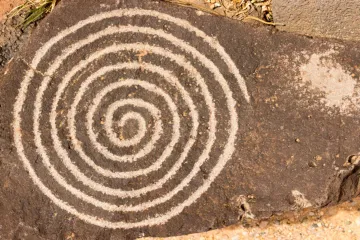
The spiral is not merely a feature of physics; it is a deeply ingrained mark of human cultural expression, dating back to the Paleolithic era. Archaeological evidence shows that the spiral was used in rock art across numerous cultures long before formal mathematics existed. In the context of ancient American sites, spirals are found carved into stone, for example, in ruins within the Arizona area, demonstrating their presence in early spiritual or narrative art.
In Celtic tradition, the spiral imagery is particularly significant and varied. Here, the symbol is often interpreted as representing the continuous cycle of life, death, and rebirth. It can symbolize the unfolding journey of life, or conversely, the path inward toward the center of existence or the self. These ancient uses clearly assign a meaning related to cyclical movement and transformation to the shape.
Comparing these ancient uses with modern contexts, the enduring power of the symbol is clear. While a modern physicist studies the spiral in galactic arms, an archaeologist studies the same form in a Neolithic carving. The difference lies in the interpretation: for the physicist, it's a result of gravity and angular momentum; for the ancient artisan, it was a symbol of vital force.
# Spiritual Paths
The deep connection between the spiral form and concepts of consciousness and spirit is perhaps where the symbol gains its most profound power. It is often viewed as a path representing the growth of consciousness, an outward journey of manifestation, or an inward quest for truth.
Some philosophical traditions suggest an etymological link between the words for "spiral" and "spirituality" in various languages, although linguistic evidence can sometimes be tenuous. Regardless of direct word origins, the conceptual link is undeniable. The spiral embodies dynamism; it is never static. In Theosophical thought, the spiral is seen as a living form that embodies movement, change, and the unfolding of an object's true nature through successive cycles.
The direction of the spiral carries distinct symbolic weight depending on the cultural context.
- Outward Spiral: Often associated with creation, growth, dispersion, and the emergence of energy from a single point into the cosmos.
- Inward Spiral: Typically associated with return, meditation, withdrawal from the material world, and the focusing of energy toward a central essence.
This duality allows the spiral to serve as a model for both the macrocosm—the universe expanding—and the microcosm—the individual turning inward for reflection. It beautifully encapsulates the idea that life is a constant process of movement through experiences, rather than simply moving to a final destination. If we see life as a series of repeating lessons or stages, the spiral provides the perfect geometric metaphor for progressing through those stages while continually returning to a similar theme at a different, more evolved level.
# Cosmic Scale
Moving back from the symbolic and the terrestrial to the truly vast, the spiral helps us conceptualize energy and motion on cosmic scales. In astrophysics, the structure of spiral galaxies is not random; it is governed by the mechanics of rotation and gravity. The spiral arm structure is maintained by density waves moving through the galactic disk, compressing gas and triggering star formation in their wake. This structure is a large-scale analogue to the fluid dynamics seen in smaller systems like hurricanes.
Considering the implications of these vast, rotating systems, we see the spiral acting as a universal mechanism for organizing matter and energy. Whether it is the accretion disk around a black hole or the shape of a galaxy, the curve provides the most stable or dynamic configuration for a rotating mass under the influence of its own gravity.
An interesting point of contemplation arises when comparing the scale of the patterns. The structure that defines the curve in a nautilus shell is determined by cellular growth rates and available material, while the structure defining a spiral galaxy is determined by dark matter halos and rotational velocity. Yet, the mathematical formula that best describes both curves—the logarithmic spiral—remains incredibly similar. This consistency across such extreme differences in scale and composition strongly suggests that the spiral form is not merely an aesthetic choice but a fundamental signature of dynamic equilibrium in the universe, regardless of the matter involved. The universe seems to possess an inherent bias toward this specific geometry when energy is in motion around a central point.
The very act of drawing or visualizing a spiral engages the observer in this universal principle. When an artist sketches the pattern, they are, whether consciously or not, reproducing the visual syntax of both cellular life and cosmic structure. This inherent connection makes the symbol incredibly powerful, offering a visual shortcut to understanding continuous process and interconnectedness. It is a shape that bridges the gap between the physical world described by physics and the metaphysical world described by belief systems, all stemming from a simple geometric progression.
Related Questions
#Citations
The Spiral: An Ancient Model Useful for Contemporary Times
The Spiral | Uzumaki Wiki - Fandom
The ancient enigma that still resonates today - BBC
Spiral - Wikipedia
One simple beautiful spiral. From what I have read the spiral may be ...
The Symbolism of the Spiral in Celtic Imagery | Ancient & Oriental
Do the English words for spirituality and spiral have common roots?
Galaxies, Spiral, Nature of Spiral Arms
The Spiral Shape Expresses the Expanding Consciousness of Nature
Spiral - Theosophy Trust