When did Immanuel Kant propose the nebular hypothesis?
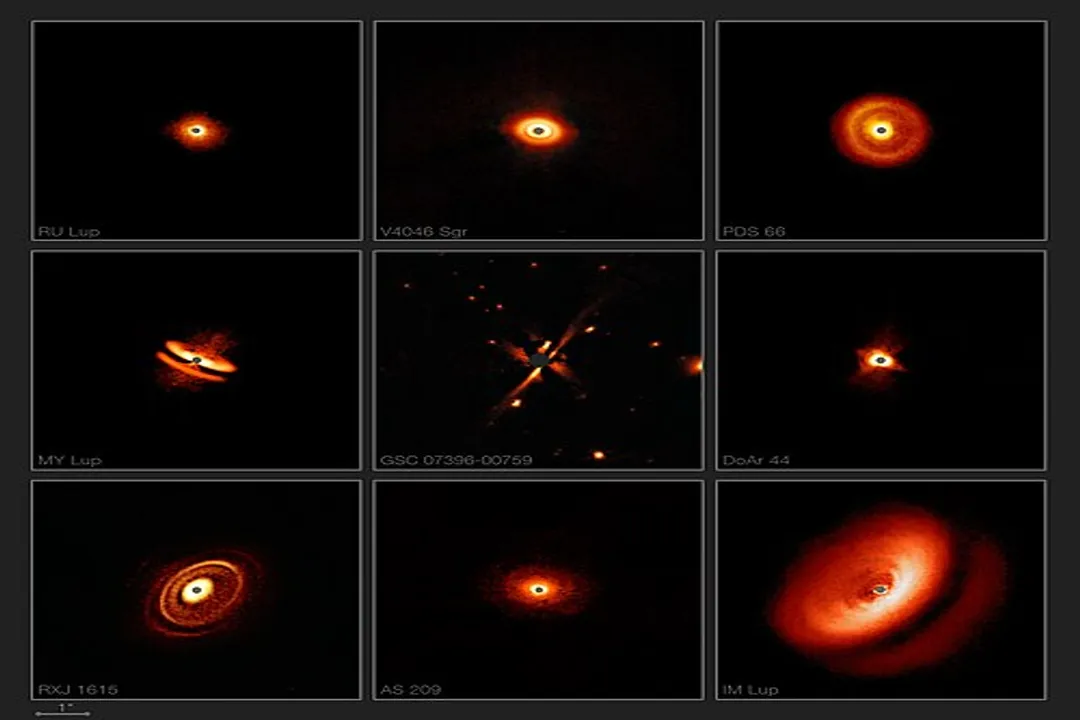
The proposition of how our solar system actually came to be has occupied thinkers for centuries, often sitting at the intersection of astronomy, physics, and natural philosophy. When Immanuel Kant addressed this fundamental question, he introduced a mechanism that would profoundly influence subsequent scientific thought, laying down one of the earliest systematic explanations for the formation of the Sun and its orbiting planets from a vast cloud of material. [1][2] Kant's significant contribution to this cosmological model was formalized in the mid-eighteenth century, specifically in the year 1755. [1]
# The Landmark Work

Kant published his theory in his work titled Universal Natural History and Theory of the Heavens (Allgemeine Naturgeschichte und Theorie des Himmels). [1] This text presented a systematic description of how the cosmos developed, suggesting that the nebular hypothesis—the idea that solar systems arise from the gravitational collapse and subsequent flattening of a rotating cloud of interstellar gas and dust—was a viable physical explanation. [2][7] For a philosopher primarily known for his later critiques of pure reason, this earlier scientific venture demonstrates an impressive breadth of inquiry into the mechanics of the universe. [3]
The specific date of 1755 marks the moment Kant provided a structured, written account of this idea, setting it apart from earlier, often mythological or theological, accounts of creation. [1] It is important to distinguish this formal proposal from the general concept of a rotating cloud, which had precursors, but Kant integrated it into a coherent, mechanistic system. [6]
# Philosophical Beginnings
It is fascinating to consider the environment in which Kant composed this work. In the 18th century, the prevailing view often leaned heavily on divine intervention for cosmic arrangements. [3] To propose a system where celestial bodies arise naturally from existing matter, guided by physical laws like gravity and rotation, was a bold assertion. [6] Kant envisioned an initial, irregular distribution of matter scattered throughout space. [1] Under the influence of gravity, these particles would begin to attract one another. [1] As matter aggregated into a central mass, this proto-sun would start to rotate, causing the entire system to flatten into a rotating disk, much like dough being spun out by a baker. [1]
This early formulation was deeply rooted in what we now call natural philosophy rather than strictly modern astrophysics. While the mechanics described—collapse, rotation, flattening—are recognizable in today's standard model, Kant’s framework often incorporated metaphysical elements or was framed in a way that philosophy served as the primary tool for understanding the physical world. [3] When we look at the trajectory of scientific theory, Kant’s 1755 paper represents the transition point where natural philosophy began to demand purely physical explanations for astronomical phenomena, paving the way for mathematics and observation to take precedence in the following century. [6]

# Early Challenges and Reception
Despite the intellectual rigor Kant applied, the immediate reception of his nebular hypothesis was not one of universal acclaim or rapid acceptance. One significant hurdle for Kant was the lack of advanced observational tools capable of confirming the existence of widespread nebulae or stellar nurseries as we understand them now. [3] He was essentially theorizing about the structure of something that could only be faintly discerned, if at all, with the telescopes of the era.
Furthermore, the complexity of the publication itself likely played a role in its initial limited reach. The book was published in German, and Kant faced financial difficulties in securing its distribution, meaning that even those interested in novel cosmology might not have encountered it immediately. [3] It stands as a minor historical curiosity that one of the most significant early formulations of modern solar system formation theory required later proponents, most famously Pierre-Simon Laplace, to reintroduce and refine the concept before it gained widespread scientific footing. [1] While Laplace’s 1796 work focused more rigorously on the mathematical physics of the rotation and dynamics, the foundational concept often traces back to the 1755 model. [1][6]
To better appreciate the scientific landscape at the time, we can look at the primary elements Kant postulated versus the refined understanding of the 18th and 19th centuries:
| Feature | Kant's 1755 Postulation | Later Refinement (e.g., Laplace) | Modern Understanding |
|---|---|---|---|
| Starting Material | Irregularly distributed particles | Rotating, flattened nebula | Giant Molecular Cloud (Gas & Dust) |
| Driving Force | Gravitational attraction | Gravity and conservation of angular momentum | Gravity and turbulence |
| Resulting Shape | Flattened disk | Centrifugal force causing ring separation | Protoplanetary disk |
| Primary Focus | Natural Philosophy / System Building | Mathematical Physics / Dynamics | Fluid Dynamics / Angular Momentum Transfer |
| [1][6] |
# Evolution of the Concept
The nebular hypothesis, as originally put forth by Kant, required substantial physical development to align with observational data. Kant’s proposal described a system forming from initial chaos through self-attraction. [1] This central concept—that the structure of the solar system reflects the structure of its progenitor nebula—is the enduring legacy of the work. [2]
What Kant lacked, which later scientists would provide, was a complete physical accounting for angular momentum. In Kant’s view, the process of matter aggregating and contracting would naturally speed up rotation, explaining the flattening. [1] However, later scientists wrestled with why the Sun, despite containing almost all the mass, holds so little of the total angular momentum of the system, with most momentum residing in the planets’ orbits. [4] The modern theory addresses this through processes like magnetic braking or interactions within the early disk, elements that were not specified or fully understood in the 18th century. [4]
It is interesting to observe that for a theory proposed in 1755, its resilience lies in its core geometrical prediction: the planets should orbit in roughly the same plane and direction as the Sun rotates. [1] Even without the sophisticated mathematics of later physics, Kant correctly deduced the spatial arrangement resulting from a rotating precursor cloud, a testament to his insight into physical laws governing large systems. [6]
# Astronomy Beyond Our System
The scope of Kant’s thinking was not limited merely to the formation of our own solar neighborhood. The nebular hypothesis, in its broader sense, suggests a universal process. If the Sun formed from a nebula, then other stars showing nebulosity—those fuzzy patches in the sky observed through early telescopes—might also be in the process of forming their own systems. [1] This expanded the idea from a specific explanation for Earth and its neighbors to a cosmological principle governing star formation throughout the galaxy. [3]
This generalization is often what gives the hypothesis its staying power in scientific discourse. It shifts the focus from a singular event to a repeatable process governed by universal physics. [2] While the term "nebular hypothesis" is sometimes used interchangeably with the modern "solar nebular disk model," Kant's initial 1755 proposition acts as the philosophical grandparent to all subsequent theories claiming an initial diffuse cloud as the solar system’s origin. [7]
When we trace scientific lineage, it is crucial to recognize that acceptance often trails innovation, especially when the innovation challenges established paradigms. Kant’s contribution in 1755 was less about being immediately correct in every physical detail and more about successfully proposing a naturalistic mechanism that could, in principle, be tested and refined by future generations armed with better science. [3] His work provided the intellectual scaffolding upon which Laplace and others would later construct the mathematically rigorous edifice we recognize today. [1][6]
# Legacy and Enduring Insight
Immanuel Kant’s proposal in 1755 remains a monumental moment in the history of science because it was one of the first rigorous attempts to apply mechanistic Newtonian physics to the origin of the entire solar system. [1] He moved the discussion from speculation grounded in ancient or theological texts to speculation grounded in observable dynamics, even if the tools for full verification were missing. [3]
If we were to offer a modern perspective on Kant’s achievement, it is that he recognized the importance of conservation in a cosmic setting—the conservation of angular momentum, even if he didn't use the formal term or fully map its consequences across the entire system. The fact that a flattened disk must form from a sphere of gas—a consequence of spinning objects naturally flattening—was intuitively and mathematically grasped by Kant nearly 250 years ago. [1] This geometric necessity is the absolute bedrock of the entire field of star and planet formation study today.
Considering the era, the fact that Kant published this theory in 1755 means it predates significant advances in thermodynamics and much of modern chemistry, yet its structural argument remains compelling. It underscores that sometimes the most effective scientific leaps come from integrating seemingly disparate fields—in Kant's case, metaphysics and observational astronomy—to construct a complete narrative of natural history. The key takeaway is that while the mechanics of how that nebula evolved have been vastly updated, the genesis of the solar system from a rotating cloud, as first systematically argued by Kant in that specific year, is the hypothesis that survived the test of time. [2][6]
Related Questions
#Citations
Nebular hypothesis - Wikipedia
Nebular hypothesis | The Solar System Wiki - Fandom
Immanuel Kant, the Formation of the Solar System, and Life on Earth
How Did the Solar System Form? | Astronomy.com
Nebular Theory | Definition, Development & Problems - Lesson
What is the scientific origin of the nebular hypothesis of solar system ...
NEBULAR HYPOTHESIS Definition & Meaning - Dictionary.com
[PDF] Thoughts on the Nebular Theory of our Planetary System Formation
Nebular Hypothesis is given by whom? Mention the theory in details