What careers are in astrochemistry?
The study of astrochemistry sits at the fascinating intersection of the physical and chemical sciences, focusing on the composition, structure, and reactions of molecules in space, from distant galaxies down to the formation nurseries of new stars and planets. [1][7] Professionals in this field spend their time deciphering the chemical 'fingerprints' left by these processes, often using data collected by powerful telescopes observing the light spectra emitted by cosmic clouds. [7] While the title astrochemist might sound like a singular, highly specialized job, the actual career paths are quite diverse, blending laboratory work, theoretical modeling, and direct astronomical observation. [2][6]
# Field Scope
Astrochemistry is fundamentally about understanding the origins of matter. It investigates how simple atoms combine into complex molecules in environments like the interstellar medium (ISM)—the gas and dust between stars—and how these molecules influence star and planet formation. [1][7] This work ties directly into the larger goals of space exploration and cosmology, as the presence and abundance of certain molecules can tell scientists a great deal about the physical conditions of a region of space. [8]
The work itself often branches into several sub-disciplines. Some astrochemists focus heavily on laboratory experiments, attempting to recreate the extreme low-temperature, low-density conditions of space to see what molecules form, using techniques like matrix isolation spectroscopy. [1][6] Others lean towards computation, creating complex mathematical models to simulate chemical kinetics across vast interstellar distances or within protoplanetary disks. [1] A third group primarily works with observational data, analyzing the spectra captured by radio or infrared telescopes to identify molecular signatures—a process heavily reliant on chemistry knowledge to interpret the wavelengths seen. [7]
# Career Trajectories
When considering careers in this realm, it is important to recognize that dedicated positions titled Astrochemist are not as common as, say, Organic Chemist or Materials Scientist. [3] Instead, the expertise gained in astrochemistry opens doors to roles where chemistry, physics, and astronomy overlap significantly. [2] Successful professionals often carve out niche roles by combining their chemical expertise with high-level data analysis or instrumentation skills. [6]
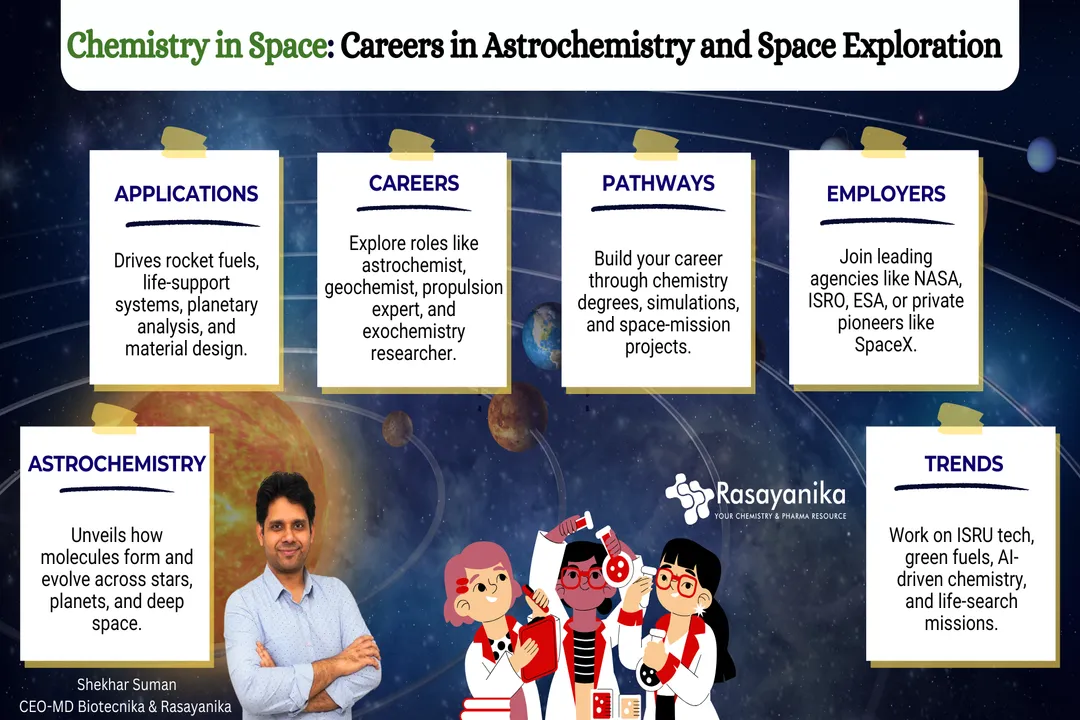
Six primary career avenues illustrate the breadth of opportunities available to those trained in astrochemistry:
- Research Scientist: This is often the most direct path, involving postdoctoral research followed by faculty positions at universities or research institutes, or roles at national laboratories. [2] These scientists typically propose research, write grant proposals, analyze observational data, and often mentor junior researchers. [6] Their focus might be on theoretical modeling or linking laboratory results to astronomical observations. [1]
- Instrument Scientist/Developer: Telescopes and analytical instruments used in astronomy—such as spectrometers—must be meticulously calibrated and often designed from the ground up. An astrochemist's deep understanding of molecular spectroscopy is invaluable for designing instruments capable of accurately detecting faint molecular lines in space. [2][6] This role blends chemical expertise with engineering.
- Computational Chemist/Modeler: These individuals create the theoretical underpinnings for the field. They use advanced computing power to simulate chemical reactions in extreme conditions that cannot be replicated on Earth, or to model the abundance of species in complex astrophysical environments. [1][2]
- Laboratory Chemist (Simulated Space Environments): This role focuses on the experimental side. Professionals in this area conduct high-vacuum, cryogenic experiments designed to mimic interstellar clouds to determine reaction pathways and produce reference spectra for comparison with astronomical data. [2][6]
- Educator and Communicator: Professionals in this area often work at universities, museums, or science centers. They translate complex findings about cosmic chemistry into understandable concepts for students and the general public, often holding positions that blend teaching with light research duties. [2]
- Data Scientist/Analyst (Observational Astronomy): While perhaps not exclusively chemistry-focused, the massive datasets produced by modern observatories require experts proficient in identifying patterns. An astrochemist brings specific knowledge to sift through spectral data, recognizing molecular signatures that a purely generalist data scientist might miss. [2]
# Workplaces
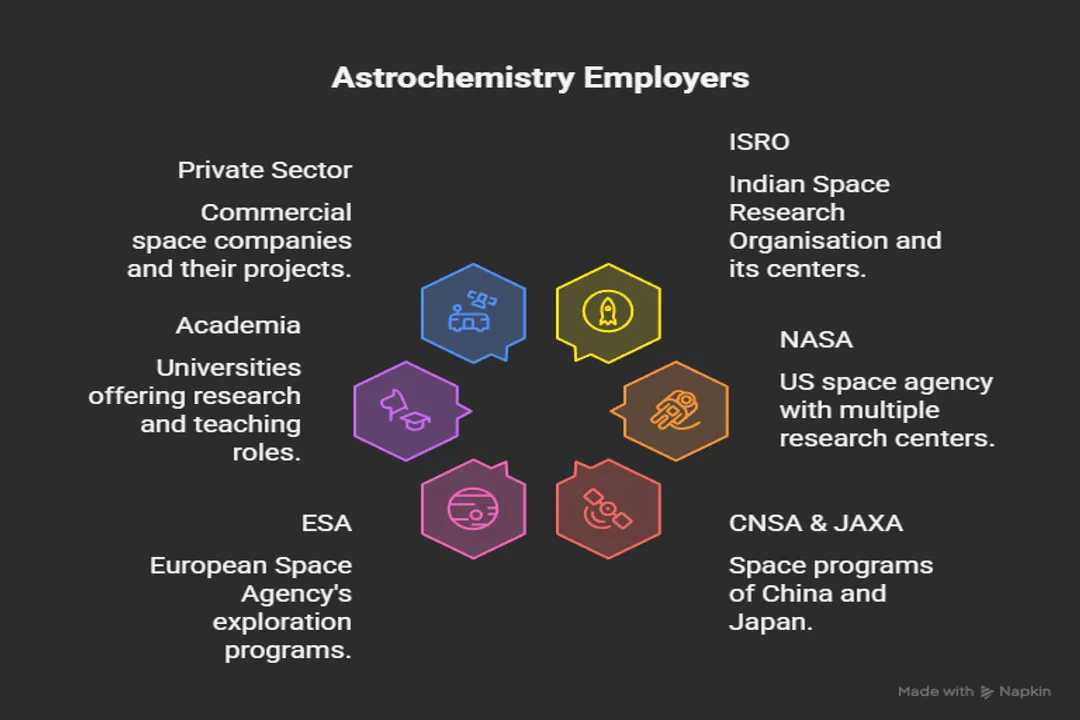
Where do these specialists actually secure employment? The landscape is dominated by academic institutions and large governmental or federally funded research organizations. [5] University positions, as noted, often involve a mix of teaching and research responsibilities. [6] Furthermore, national observatories and space agencies, such as NASA or the European Space Agency (ESA), employ scientists for mission planning, instrument development, and pure research. [5][2] While research-focused jobs in industry are less common for pure astrochemistry, skills learned in the field—especially computational modeling, spectroscopy, and vacuum technology—are highly transferable to materials science, pharmaceutical research, or advanced sensor development. [3][6]
| Career Track | Primary Focus | Key Skill Set | Typical Employer |
|---|---|---|---|
| Research Scientist | Interpreting observations; developing theory | Spectroscopy, Astrophysics, Modeling | University, National Lab |
| Instrument Scientist | Designing and calibrating detectors | Optics, Vacuum Tech, Chemical Physics | Observatories, Aerospace Contractors |
| Computational Modeler | Simulating chemical reactions | High-Performance Computing, Quantum Chemistry | University, Government Agency |
| Laboratory Chemist | Recreating space chemistry on Earth | Cryogenics, Mass Spectrometry, UHV | University, Specialized Research Center |
This table offers a quick glance at how the fundamental chemical knowledge—the expertise—gets specialized for different job functions in the field. [2]
# Educational Foundations
Entering the astrochemistry career track demands a high level of specialized education, typically starting with a bachelor's degree in chemistry or physics. [5][6] However, the field is inherently interdisciplinary, meaning a strong background in both chemistry and astrophysics/astronomy is highly beneficial even at the undergraduate level. [1][8]
Following the undergraduate degree, advanced study is almost always required. A Ph.D. is the standard prerequisite for securing independent research positions, whether in academia or national labs. [5] Doctoral programs in this area often involve extensive collaboration between chemistry departments (for lab work or computational projects) and physics or astronomy departments (for observational training). [6]
# Essential Skills
Beyond formal degrees, specific technical competencies differentiate candidates. For those leaning toward observational work, proficiency in programming languages like Python for data reduction and analysis is crucial. [1] Understanding the mathematical basis of quantum mechanics and molecular spectroscopy is non-negotiable, as it underpins the entire field of identifying molecules remotely. [7] For lab-based roles, hands-on experience with high-vacuum systems, cryogenic techniques, and advanced analytical instrumentation (like mass spectrometers or various forms of spectroscopy) is paramount. [6]
One insightful observation for those planning their academic path is the current data explosion in astronomy. Mastering data handling and visualization is perhaps as critical today as mastering reaction mechanisms. An astrochemist who can efficiently process terabytes of spectral data from facilities like ALMA or JWST, even if they aren't designing the next spectrograph, is exceptionally valuable to any research group. [7] This focus on applied computation bridges the gap between pure theoretical chemistry and frontline research findings.
# The Reality of the Niche
It is helpful for prospective students to understand that astrochemistry often functions as a focus within a broader scientific career rather than a standalone profession for many practitioners. [3] A chemist might specialize in gas-phase kinetics in their Ph.D. work, only to take a faculty position in an Astronomy department where they apply that knowledge to interstellar cloud models. [1][6] This requires flexibility in career planning.
If someone is primarily drawn to the lab work—the hands-on manipulation of chemicals—they might find more immediate, abundant positions by focusing their chemical expertise slightly away from space and toward adjacent fields like atmospheric chemistry, plasma physics, or the fundamental chemistry of aerosols, using the astrochemistry experience as the differentiator on their CV. [3] The knowledge of chemical processes under extreme dilution is portable.
Another practical consideration involves the geography of the work. While university positions are distributed, major research centers housing the largest telescopes or specialized laboratory facilities—like certain national laboratories or major observatories—often dictate where a job might be available. [5] Keeping track of where major observatories are planning their next large surveys or instrument upgrades can provide an early indication of where related postdoctoral or research staff positions might emerge in the next five to ten years. This foresight allows a candidate to tailor their thesis work to match the anticipated data stream, which is a tangible way to build authority and experience. [2]
# Research Frontiers
The careers in astrochemistry are constantly evolving as technology grants us new perspectives on the cosmos. Current research is pushing into areas requiring even more sophisticated chemical modeling and detection capabilities. [7] For instance, the search for prebiotic molecules—the chemical precursors to life—in young stellar systems is a major driver. [1] Understanding how carbon, hydrogen, oxygen, and nitrogen assemble into more complex organic molecules within the disks surrounding nascent stars informs our understanding of life's potential distribution throughout the galaxy. [8]
Another exciting area involves chemical mapping in extreme environments, such as the dense cores of molecular clouds or the material ejected by dying stars. [7] Interpreting the faint signals from these regions requires extremely accurate laboratory measurements of molecular transitions, which is where the experimental astrochemist proves their worth. [6] The constant flow between observation and experiment defines the expertise required in this niche. [1]
Ultimately, a career in astrochemistry is for someone who is deeply curious about the universe's origins and possesses the chemical rigor to quantify those mysteries. It requires an individual comfortable operating at the boundary of established disciplines, constantly learning new observational techniques alongside advanced chemical theory. [2][5]
Related Questions
#Citations
Astrochemistry - American Chemical Society
Six Careers That Combine Chemistry and Space Exploration
Astrochemistry careers? : r/chemistry - Reddit
Astrochemistry Jobs, Employment | Indeed
Who is an astrochemist? | Educate & inspire - Space Awareness
Astrochemist | Job profile - Royal Society of Chemistry: Education
Astrochemistry - Center for Astrophysics | Harvard & Smithsonian
Careers in Astrochemistry & Space Exploration - Rasayanika
6 Astrochemistry jobs - Academic Positions