career articles
What are the primary undergraduate majors for aspiring astronomers?
What is cited as the single most impactful activity for an undergraduate aspiring to research?
Which degree is almost universally required to secure a position as a research astronomer?
Approximately how long does commitment to a PhD program typically span beyond the undergraduate degree?
Beyond foundational physics and math, what skills are heavily weighted for modern astronomers?
What is a primary reason astronomers must be proficient in programming languages like Python or C++?
What must rigorously support every conclusion drawn about a star's mass, age, or composition?
Which of the following is NOT explicitly listed as a specialized area within stellar astronomy?
What common temporary step often follows completing a PhD before many astronomers secure a permanent role?
Due to transferable foundational skills, where might an astronomer with a PhD successfully transition outside of traditional academic research?
What discipline underpins every successful NASA mission from launch to data return?
What are chemists at launch facilities like KSC frequently examining and certifying for thrust?
What specialized chemistry field focuses on the composition and reactions of molecules in interstellar clouds and planetary atmospheres?
What is the primary optimization goal for a NASA chemist operating in an environment hostile to known chemical systems?
What foundational expertise is almost always required for NASA chemists across various specializations?
What is the primary focus of materials chemistry specialists in the context of space travel?
What degree is generally sought for NASA candidates pursuing roles involving deep research or mission science?
What comparison highlights the difference between an Astrochemist modeling distant plumes and a Propellant Chemist at KSC?
What specific contamination concern requires NASA labs to employ ultra-trace analysis techniques often measured in parts-per-trillion?
What skills, besides a core chemistry degree, are becoming increasingly valuable add-ons for modern NASA chemists?
What primary focus defines the study of astrochemistry?
How do astrochemists typically decipher the chemical 'fingerprints' left by cosmic processes?
Which technique is mentioned specifically for laboratory astrochemists recreating space conditions?
What is a common progression for a Research Scientist role in astrochemistry?
Why is an astrochemist's expertise valuable for an Instrument Scientist/Developer?
What programming skill is crucial for those leaning toward observational data analysis in astrochemistry?
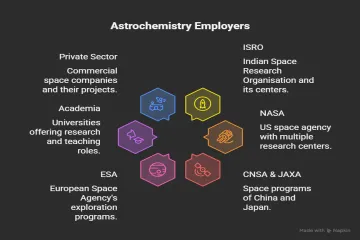
Which types of institutions currently dominate the employment landscape for astrochemists?
What advanced degree is typically the standard prerequisite for securing independent research positions in astrochemistry?
If pure astrochemistry research jobs are limited, skills like computational modeling and spectroscopy are highly transferable to which adjacent fields?