electron microscope articles
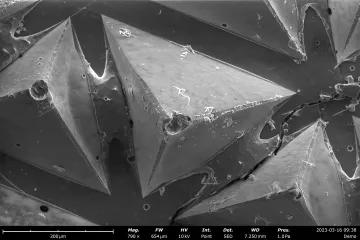
What fundamental physical limitation do electron microscopes bypass that constrains traditional light microscopes?
What is the direct physical reason for the superior resolving power of an electron microscope compared to a light microscope?
What is the typical maximum magnification limit for conventional light microscopes?
What specific cellular components can electron microscopes visualize in extraordinary detail?
What preparation step is typically necessary for biological samples in most electron microscopy, limiting observation of living processes?
What is the primary function and resulting image characteristic of Scanning Electron Microscopy (SEM)?
How is an image generated using Transmission Electron Microscopy (TEM)?
In a TEM image, what causes specific areas of the sample cross-section to appear darker?
Beyond biology, what structural element relevant to physical properties can electron microscopy reveal in materials science?
What functional information about a material can be mapped simultaneously with structure using techniques like Cathodoluminescence Spectroscopy (CL)?
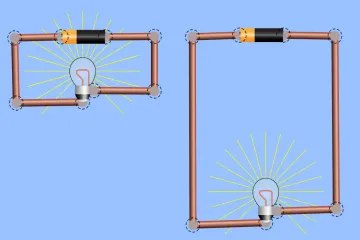
What is the typical speed of free electrons in a metal conductor when no net current is flowing?
What is the primary governor that initiates and sustains the directed flow of electrons in a conductor?
What scale characterizes the average drift velocity ($\mathbf{v}_d$) of electrons in a common household wire?
What characterizes the valence electrons in solid metals that enables them to be electrical conductors?
Relative to the direction of the electric field lines, in which direction is the net force exerted on an electron?
What is the speed associated with the propagation of the electrical signal or electromagnetic field along a wire?
What is the consequence when an electron accelerates under an electric field and subsequently collides with a positive ion core?
Why does turning on a light switch result in nearly instantaneous illumination?
What defines the mobility ($\mu$) of electrons in a conductor?