diagram articles
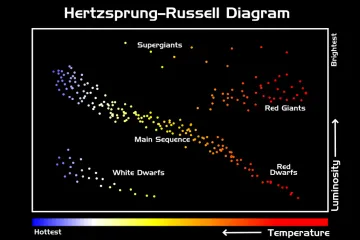
What two stellar properties does the Hertzsprung-Russell diagram map against each other?
On the H-R diagram, where are the coolest stars generally located?
What physical characteristic allows Red Giants and Red Supergiants to be luminous despite having low surface temperatures?
Which spectral types generally correspond to coolness on the main sequence of the H-R diagram?
What specific region of the H-R diagram is occupied by Red Giants and Red Supergiants?
What is the primary characteristic that defines the position of Red Dwarfs on the H-R diagram?
What is the estimated surface temperature range for Red Giants and Red Supergiants?
Why are Red Giants relatively rare compared to main-sequence stars?
What spectral class predominantly identifies the Red Dwarfs?
Due to $L Arr T^4$, where does most of the radiation from very cool stars like Red Dwarfs primarily fall on the electromagnetic spectrum?
What stellar characteristic dictates the position of stars along the main sequence band?

What two fundamental physical characteristics are mapped against each other on the H-R diagram?
How is surface temperature represented on the standard H-R diagram's horizontal axis?
What primary physical process defines a star while it resides on the Main Sequence?
What characteristic primarily governs the position of a star along the Main Sequence band?
Which region of the H-R diagram is occupied by Red Giants or Supergiants?
What physical property resolves the apparent contradiction of Red Giants being both highly luminous and relatively cool?
Where are White Dwarfs clustered on the H-R diagram?
Why do White Dwarfs exhibit very low luminosity despite being extremely hot?
What is the longest, most stable phase of stellar life represented on the H-R diagram?